Advertisements
Advertisements
प्रश्न
Distinguish between inspiration and expiration.
Advertisements
उत्तर
| No. | Inspiration | Expiration |
| i. | Atmospheric air is taken into the lungs. | Air rushes out from the lungs. |
| ii. | It is an active process. | It is a passive process. |
| iii. | Contraction of external intercostal muscles occurs. | Relaxation of external intercostal muscles occurs. |
| iv. | Diaphragm contracts and becomes flattened. | Diaphragm relaxes and becomes original dome shaped. |
| v. | Increase in volume of thoracic cavity. | Decrease in volume of thoracic cavity. |
APPEARS IN
संबंधित प्रश्न
Distinguish between photosynthesis and aerobic respiration.
Why do we often sneeze when we inhale a lot of dust-laden air?
Short answer question.
Why is it advantageous to breathe through the nose than through the mouth?
Long answer question:
Smita was working in a garage with the doors closed and automobile's engine running. After some time she felt breathless and fainted. What would be the reason? How can she be treated?
Explain why you are not able to breathe normally when you are in closed and crowded places?
When 1500 mL air is in the lungs, it is called ______.
During inspiration, the inter-costal muscles ____________.
Identify the role of NAD+ in cellular respiration
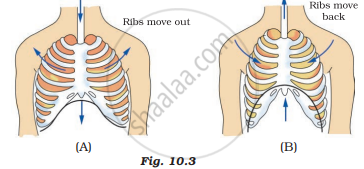
Observe the figures given in Figures 10.3 (A) and (B) and answer the following.
In the figure label the arrows and indicate the direction of
- movement of air
- movement of the diaphragm
- movement of ribs
Identify the wrong statement with reference to the transport of oxygen.
