Advertisements
Advertisements
Question
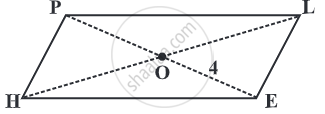
Diagonals of a parallelogram are perpendicular to each other. Is this statement true? Give reason for your answer.
Advertisements
Solution
The given statement is not true because diagonal of a parallelogram bisect each other.
APPEARS IN
RELATED QUESTIONS
Diagonals of a parallelogram `square`WXYZ intersect each other at point O. If ∠XYZ = 135° then what is the measure of ∠XWZ and ∠YZW?
If l(OY)= 5 cm then l(WY)= ?
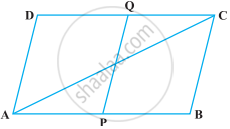
Points P and Q have been taken on opposite sides AB and CD, respectively of a parallelogram ABCD such that AP = CQ (Figure). Show that AC and PQ bisect each other.
A diagonal of a parallelogram bisects one of its angles. Show that it is a rhombus.
In the following figure, AB || DE, AB = DE, AC || DF and AC = DF. Prove that BC || EF and BC = EF.

P and Q are points on opposite sides AD and BC of a parallelogram ABCD such that PQ passes through the point of intersection O of its diagonals AC and BD. Show that PQ is bisected at O.
ABCD is a rectangle in which diagonal BD bisects ∠B. Show that ABCD is a square.
If the diagonals of a quadrilateral bisect each other, it is a ______.
Two sticks each of length 5 cm are crossing each other such that they bisect each other. What shape is formed by joining their endpoints? Give reason.
Two sticks each of length 7 cm are crossing each other such that they bisect each other at right angles. What shape is formed by joining their end points? Give reason.
