Advertisements
Advertisements
Question
Describe with the help of a diagram, how compressions and rarefactions are produced in air near a source of sound.
Advertisements
Solution
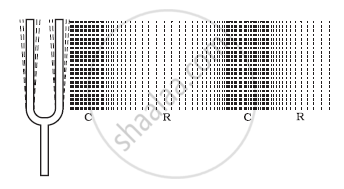
Let us assume that a tuning fork is the source of sound.
- When it vibrates and moves forward, it pushes and compresses the air in front of it, thus creating a region of high pressure. This region is called compression (C).
- This compression moves forward away from the vibrating object, such as the tuning fork.
- When the arm of the tuning fork vibrates back inwards (backwards), a low-pressure region is created, which is called rarefaction (R).
- When an object vibrates this way, a series of compressions and rarefactions are created in the air. These compressions and rarefactions form sound waves, which propagate through the medium.
RELATED QUESTIONS
Fill in the blank.
Sound requires a ________ for propagation.
Select the correct alternative :
Sound cannot travel in
Can sound travel through a vacuum ? Describe an experiment to explain your answer.
Define the terms 'frequency', 'wavelength' and 'velocity' of a sound wave. What is the relation between them?
Sound travels in air :
Describe an experiment to prove that a material medium is necessary for the propagation of sound.
Does the speed of sound in a gas depend on the pressure of the gas?
Can we hear sounds of frequencies:
Less than 20 Hz
When we hear a sound, does any part of our body vibrate? Name the part.
The small to and fro motion is called vibration.
