Advertisements
Advertisements
प्रश्न
Describe with the help of a diagram, how compressions and rarefactions are produced in air near a source of sound.
Advertisements
उत्तर
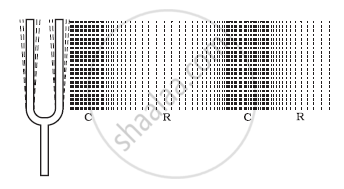
Let us assume that a tuning fork is the source of sound.
- When it vibrates and moves forward, it pushes and compresses the air in front of it, thus creating a region of high pressure. This region is called compression (C).
- This compression moves forward away from the vibrating object, such as the tuning fork.
- When the arm of the tuning fork vibrates back inwards (backwards), a low-pressure region is created, which is called rarefaction (R).
- When an object vibrates this way, a series of compressions and rarefactions are created in the air. These compressions and rarefactions form sound waves, which propagate through the medium.
संबंधित प्रश्न
Cite an experiment to show that sound needs a material medium for its propagation.
Define the terms 'frequency', 'wavelength' and 'velocity' of a sound wave. What is the relation between them?
Fill in the blank with suitable word.
Sound cannot travel through ____________.
The velocities of sound waves in four media P, Q, R and S are 18,000 km/h, 900 km/h, 0 km/h and 1200 km/h respectively. Which medium could be a liquid substance?
Describe in brief, with the aid of a lebelled diagram, an experiment to demonstrate that a material medium is necessary for propagation of sound.
How does the speed of sound in air vary with temperature?
Assuming the speed of sound in air equal to 340 m/s and in water equal to 1360 m/s, find the time taken to travel a distance 1700 m by sound in (i) air (ii) water.
Can we hear sounds of frequencies:
Less than 20 Hz
Does audible range of frequency vary from person and also with the age of the person?
Name the Sound of the Frequency Given Below:
2000 Hz
