Advertisements
Advertisements
प्रश्न
Describe with the help of a diagram, how compressions and rarefactions are produced in air near a source of sound.
Advertisements
उत्तर
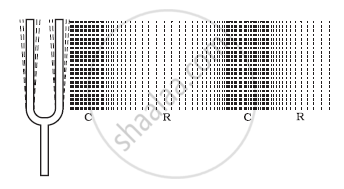
Let us assume that a tuning fork is the source of sound.
- When it vibrates and moves forward, it pushes and compresses the air in front of it, thus creating a region of high pressure. This region is called compression (C).
- This compression moves forward away from the vibrating object, such as the tuning fork.
- When the arm of the tuning fork vibrates back inwards (backwards), a low-pressure region is created, which is called rarefaction (R).
- When an object vibrates this way, a series of compressions and rarefactions are created in the air. These compressions and rarefactions form sound waves, which propagate through the medium.
संबंधित प्रश्न
Fill in the blank.
Sound requires a ________ for propagation.
Explain why, a ringing bell suspended in a vacuum chamber cannot be heard outside.
Define the terms 'frequency', 'wavelength' and 'velocity' of a sound wave. What is the relation between them?
Sound travels in air :
Assuming the speed of sound in air equal to 340 m/s and in water equal to 1360 m/s, find the time taken to travel a distance 1700 m by sound in (i) air (ii) water.
Do all animals have same ranges of audible frequencies?
Name the Sound of the Frequency Given Below:
2000 Hz
Ruthvik and Ruha hear a gunshot 2 second after it is fired. How far away from the gun they are standing? (Speed of sound in air is equal to 330ms-1)
In any medium, as the ______ increases, the speed of sound also increases.
The amount of water vapour present in the air is known as ______.
