Advertisements
Advertisements
Questions
Describe the locus of vertices of all isosceles triangles having a common base.
Draw and describe the locus in the following case:
The locus of vertices of all isosceles triangles having a common base.
Advertisements
Solution

The locus of vertices of all isosceles triangles having a common base will be the perpendicular bisector of the common base of the triangles.
RELATED QUESTIONS
On a graph paper, draw the lines x = 3 and y = –5. Now, on the same graph paper, draw the locus of the point which is equidistant from the given lines.
AB and CD are two intersecting lines. Find a point equidistant from AB and CD, and also at a distance of 1.8 cm from another given line EF.
In Δ PQR, s is a point on PR such that ∠ PQS = ∠ RQS . Prove thats is equidistant from PQ and QR.
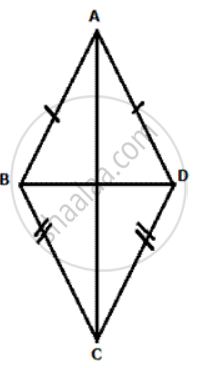
In given figure, ABCD is a kite. AB = AD and BC =CD. Prove that the diagona AC is the perpendirular bisector of the diagonal BD.
Describe completely the locus of a point in the following case:
Midpoint of radii of a circle.
Describe completely the locus of a point in the following case:
Centre of a ball, rolling along a straight line on a level floor.
State and draw the locus of a swimmer maintaining the same distance from a lighthouse.
State and draw the locus of a point equidistant from two given parallel lines.
Without using set squares or a protractor, construct:
- Triangle ABC, in which AB = 5.5 cm, BC = 3.2 cm and CA = 4.8 cm.
- Draw the locus of a point which moves so that it is always 2.5 cm from B.
- Draw the locus of a point which moves so that it is equidistant from the sides BC and CA.
- Mark the point of intersection of the loci with the letter P and measure PC.
Given ∠BAC (Fig), determine the locus of a point which lies in the interior of ∠BAC and equidistant from two lines AB and AC.
