Advertisements
Advertisements
Question
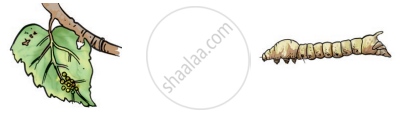
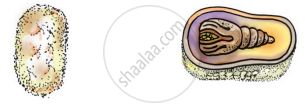
Describe the life history of the silk moth with the help of figures of various stages.
Advertisements
Solution
The female silk moth lays eggs. When an egg hatches, a tiny caterpillar crawls out. This is the silkworm or larva. The silkworm feeds on mulberry leaves and grows. When it is ready to enter the next stage in its life cycle, it first weaves a net to hold itself. It then secretes a fibre made of proteins, which hardens on exposure to air. This is the silk fibre. It covers itself completely with this fibre, to form a cocoon. At this stage, the larva is called a pupa. The pupa grows and changes inside the cocoon. A few weeks later, the cocoon opens and an adult moth comes out.
APPEARS IN
RELATED QUESTIONS
Out of the following, which are the two terms related to silk production?
Sericulture, floriculture, moriculture, apiculture and silviculture
Hints:
(1) Silk production involves cultivation of mulberry leaves and rearing silkworms.
(2) Scientific name of mulberry is Morus alba.
Match the words of Column I with those given in Column II:
| Column I | Column II |
| Scouring | Yields silk fibres |
| Mulberry leaves | Wool yielding animal |
| Yak | Food of silk worm |
| Cocoon | Reeling |
| Cleaning sheared skin |
______ is the strongest natural fibre.
Silk fibre is obtained from ______.
The general process that takes place at a sheep shearing shed is ______.
State whether the following statement is True or False. If false, correct them.
Silkworms are caterpillars of silk moth.
Some words related to silk are jumbled up. Write them in their correct form.
WILSMORK
Some words related to silk are jumbled up. Write them in their correct form.
RINGLEE
Silk is the secretion of ______.
List a few characteristic features of silk.
