Advertisements
Advertisements
प्रश्न
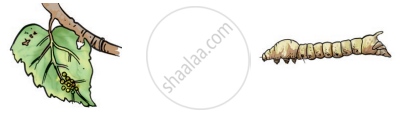
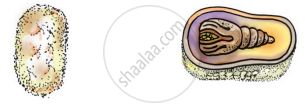
Describe the life history of the silk moth with the help of figures of various stages.
Advertisements
उत्तर
The female silk moth lays eggs. When an egg hatches, a tiny caterpillar crawls out. This is the silkworm or larva. The silkworm feeds on mulberry leaves and grows. When it is ready to enter the next stage in its life cycle, it first weaves a net to hold itself. It then secretes a fibre made of proteins, which hardens on exposure to air. This is the silk fibre. It covers itself completely with this fibre, to form a cocoon. At this stage, the larva is called a pupa. The pupa grows and changes inside the cocoon. A few weeks later, the cocoon opens and an adult moth comes out.
APPEARS IN
संबंधित प्रश्न
The cultivation and production of silk is known as ______.
______ is the strongest natural fibre.
Which of the following is not a type of silk?
Silk fibre is obtained from ______.
Some words related to silk are jumbled up. Write them in their correct form.
TURECULRISE
Steps for the production of silk are given below in a jumbled order. Arrange them in their proper sequence.
- Eggs are warmed to a suitable temperature for the larvae to hatch from eggs.
- Fibres are taken out from the cocoon.
- After 25 to 30 days, the caterpillars stop eating and start spinning cocoons.
- The larvae/caterpillars or silkworms are kept in clean trays along with freshly chopped mulberry leaves.
- Female silk moths lay eggs.
- Cocoons are kept under the sun or boiled in water.
Complete the paragraph related to the life history of silk moth by filling in the blanks.
The ___(a)___ silk moth lays ___(b)___, from which hatch ___(c)___ called ___(d)___ or ___(e)___. They grow in size and when the caterpillar is ready to enter the next stage of its life history called ___(f)___, it first weaves a covering to hold itself, which is known as ___(g)___.
India stands ______ in silk production in the world.
The larva of a silkworm is called ______.
List a few characteristic features of silk.
