Advertisements
Advertisements
Question
Describe the function of the heart.
Advertisements
Solution 1
- The heart contains four chambers: two upper chambers, known as atria, and two lower chambers, known as ventricles. The left and right chambers are entirely divided to prevent the mixing of oxygen- and carbon dioxide-rich blood.
- The vena cava (main vein) transports deoxygenated blood from all over the body to the right atrium. This blood is pumped from the right atrium to the right ventricle, which subsequently delivers it to the pulmonary artery, which carries blood to the lungs for oxygenation.
- The left atrium receives oxygenated blood via pulmonary veins (2 each from the right and left lungs). The blood is subsequently pumped into the left ventricle, which in turn pumps it into the aorta (main artery), where it is distributed throughout the body.
The circulation of blood can be illustrated by the following flow chart:

Solution 2
- The heart circulates pure blood throughout the body and into the sea.
- The blood in the body is mixed and circulated to the lungs, heart and liver for purification.
- The heart transports water and other useful medicines to all the seas through the blood.

APPEARS IN
RELATED QUESTIONS
Given below is a certain structure, write its chief functional activity.
Bone marrow - ______.
The valve which prevents back flow of blood in the veins and lymph vessels ______.
Production of RBCs occurs in ______.
Why does the left ventricle possess a thicker wall than the right ventricle?
The oxygen-rich blood from the lungs comes into the ______ of the heart.
Write a short note on the human heart.
Draw well labeled diagrams of part Artery and Superior vena cava to show the structural.
______ WBCs are present per mm3 of blood.
Which of the following is the main site of erythropoiesis in adults?
Given diagram is a schematic representation of the circulatory system in humans. Study the same and answer the questions that follow:
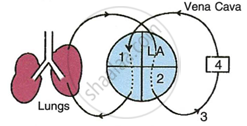 |
- Label the parts 1 and 4 indicated in the diagram.
- Which of the above mentioned number is the thickest artery? Also write its name.
- Mention the number and chamber of the heart which has the thickest muscular wall.
- Which of the above numbers/structures has the maximum number of blood capillaries?
- Draw neat and labelled diagrams of the transverse section of vena cava and the part numbered as 3. Make sure to show the structural differences between these two in the diagram.
