Advertisements
Advertisements
Question
Describe, how you will proceed to determine the position of the pole of a bar magnet.
Advertisements
Solution
Fix a white sheet of paper on a wooden drawing board and in the middle of it draw a straight line. On the straight line place a magnetic needle. Turn the drawing board in the clockwise or anticlockwise direction, till the magnetic needle is in line with
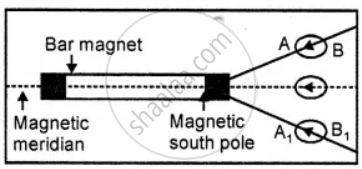
line drawn on drawing board. At this point drawing board is in magnetic meridian. Remove the magnetic needle.
Place a bar magnet such that its axis coincides with this line. Mark the outline of the magnet with a pencil. Place the compass needle near one end of the bar magnet. In this position, the action of the earth’s field is ineffective in deflecting the needle and the compass needle is acted on by the nearest pole only. Market the two ends of the needle by two dots A and B as shown in the figure.
Change the position of the compass needle and repeat the process. Join the two marks A, B, and A,, B, by straight lines. It will be found that the straight lines, when produced, intersect at a point near the end of the magnet. This point of intersection indicates the position of the magnetic pole. Similarly, the other pole may be ascertained in the same way as described above. The length between the two poles is called the effective length of the magnet which is found to be about 0.84 times the actual length of the magnet.
APPEARS IN
RELATED QUESTIONS
Describe a simple experiment to illustrate that like poles of two magnets repel each other while the unlike poles attract ?
Name four appliances which work using electricity ?
Which magnet will you use?
A window shutter opens and shuts continuously in the wind.
Bar magnets are often stored in pairs as shown in the figure. E and F being pieces of metal.
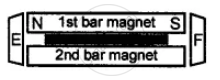
Why are E and F placed in contact with the poles of the magnets as shown in the diagram?
If a magnet is carefully broken into two pieces as shown in figure (i), how does the magnetic strength of each piece compare with that of the original magnet? If another magnet is carefully broken in half along its long axis shown in figure (ii), how would the strength of each piece compare with that of the original magnet?
Define the following term:
Magnetic meridian
Explain the following:
Resistance of a conductor
The strongest natural magnet is ______.
