Advertisements
Advertisements
प्रश्न
Describe, how you will proceed to determine the position of the pole of a bar magnet.
Advertisements
उत्तर
Fix a white sheet of paper on a wooden drawing board and in the middle of it draw a straight line. On the straight line place a magnetic needle. Turn the drawing board in the clockwise or anticlockwise direction, till the magnetic needle is in line with
line drawn on drawing board. At this point drawing board is in magnetic meridian. Remove the magnetic needle.
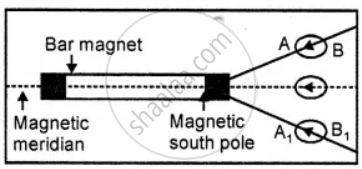
Place a bar magnet such that its axis coincides with this line. Mark the outline of the magnet with a pencil. Place the compass needle near one end of the bar magnet. In this position, the action of the earth’s field is ineffective in deflecting the needle and the compass needle is acted on by the nearest pole only. Market the two ends of the needle by two dots A and B as shown in the figure.
Change the position of the compass needle and repeat the process. Join the two marks A, B, and A,, B, by straight lines. It will be found that the straight lines, when produced, intersect at a point near the end of the magnet. This point of intersection indicates the position of the magnetic pole. Similarly, the other pole may be ascertained in the same way as described above. The length between the two poles is called the effective length of the magnet which is found to be about 0.84 times the actual length of the magnet.
APPEARS IN
संबंधित प्रश्न
Name four appliances which work using electricity ?
State if the following statement is true or false. Correct the statement if it is false.
As we move away from a magnet, its attraction power weakens.
Answer the following in detail.
Write a short note on the theory of magnetism.
Answer the following in detail.
How is the single-touch method of magnetism different from the double-touch method?
Answer the following in detail.
How can a magnet be demagnetized?
Define the following term regarding a bar magnet:
Effective length
The alloys called ______ and ______ are used for making industrial magnets.
Define the following term:
Geographic meridian
Which is not attracted by a magnet?
Define natural magnet.
