Advertisements
Advertisements
Question
Describe how the exchange of oxygen and carbon dioxide gases takes place in the lungs.
Advertisements
Solution
At the time of respiration, the external air reaches up to the alveoli in the lungs. The oxygen in the air enters the blood vessels, which surround the alveoli. Through the network of blood vessels, oxygen is supplied to the entire body. At the same time, carbon dioxide is brought by the circulating blood into the alveoli. From here, carbon dioxide is given out of the body through exhalation. In this way, the exchange of oxygen and carbon dioxide gases takes place in the alveoli of the lungs.
APPEARS IN
RELATED QUESTIONS
The diagram given below represents a section of the human heart. Answer the questions that follow:
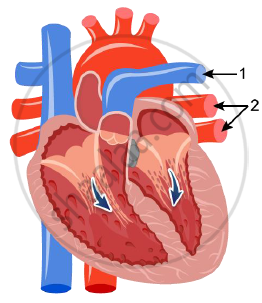
- Which parts of heart are in the diastolic phase? Give a reason to support your answer.
- Label the parts numbered 1 and 2 in the diagram. What type of blood flows through them?
- What causes the heart sounds ‘LUBB’ and ‘DUP’?
- Name the blood vessels that supply oxygenated blood to the heart muscles.
- Draw neat labelled diagrams of a cross section of an artery and a vein.
State the exact location of the Chordae tendinae
Differentiate between members of the following pairs with reference to the aspect asked within bracket:
artery and vein (type of blood primarily flowing through)
Give reason for the following:
The walls of the left ventricle are thicker than the walls of all other chambers.
Given diagram shows a simple diagram of the circulation of blood in a mamma showing the
main blood vessels, the heart, lungs and body tissues. The blood vessel, labelled 6, contains
deoxygenated blood and the valve leading to it has three semi-lunar pockets.

(a) Name the blood vessels and organs marked by numbers 1 to 8.
(b) What is meant by the term ‘double circulation’ of blood in mammals?
(c) what is diastole?
[There is an “error” in the diagram. According to the usual practice the pulmonary (lung)
circulation is shown upward and the systemic downward, but here it is reversed].
Explain the structure and function of human blood.
Choose the correct answer:
English physician who discovered blood circulation was ___________
Name the main parts of the circulatory system.
In what ways does the blood entering the kidney differ from that leaving the kidney?
Identify the function of the erythropoietin hormone produced by kidney cells.
