Advertisements
Advertisements
Questions
Define the Circulatory system.
Define the following term:
Circulatory system
Advertisements
Solution
The circulatory system is a transport system moving substances throughout our body with the help of blood.
RELATED QUESTIONS
What is meant by human circulatory system?
The cells in our blood which destroy disease-causing germs are ______.
Describe the circulatory system of humans.
Name the following:
The smallest common blood vessels formed by the union of capillaries.
When are the sounds "LUBB" and "DUP" produced respectively during heart beat?
Differentiate between members of the following pairs with reference to the aspect asked within bracket:
Artery and vein (direction of blood flow)
Match the items in Column ‘A’ with those in column ‘B’ Rewrite the correct matching pairs.
| Column A | Column B | ||
| (a) | SA Node | (i) | Plasma |
| (b) | Defective haemoglobin in RBC | (ii) | Serum |
| (c) | Muscle fibres located in heart | (iii) | Pacemaker |
| (d) | The liquid squeezed out of blood during clotting | (iv) | Sickle cell anaemia |
| (e) | Never tires, keep on contracting and relaxing | (v) | Purkinje fibres |
| (f) | Cardiac cycle | (vi) | Cardiac muscle |
| (g) | Liquid part of the blood without corpuscles | (vii) | 0·85 sec |
How do you account for the following difference?
The walls of the right ventricle are thicker than those of the right auricle.
Given below is a highly schematic diagram of the human blood circulatory system.
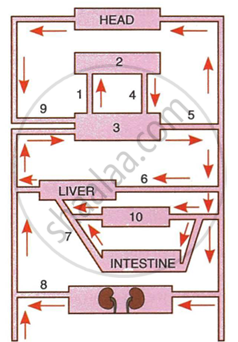 |
- Which part (state the number) represents the heart? Give reason in support of your answer.
- Which numbers represent the following, respectively?
Aorta Superior vena cava Hepatic portal vein Renal Vein Pulmonary artery Stomach
Explain the structure and function of human blood.
Fill in the blank:
In human body, heart is located on the _____ side of the chest cavity.
What are seen as greenish blue lines in our hands and legs?
Differentiate between:
Open circulatory system and Closed circulatory system.
Draw well labeled diagrams of part Artery and Superior vena cava to show the structural.
Label the diagram given below to show the four main parts of the urinary system and answer the following questions.

- Which organ removes extra salts and water from the blood?
- Where is the urine stored?
- What is the tube through which urine is excreted out of the body?
- What are the tubes that transfer urine from the kidneys to the urinary bladder called?
______ prevent blood clotting.
Identify the INCORRECT match
Which of the following is TRUE regarding closed circulatory system?
The heart is covered by ______.
Mention the phase of heart beat in which both the atrio-ventricular valves are closed.
