Advertisements
Advertisements
Question
Define Spermatogenesis.
Advertisements
Solution
Spermatogenesis is the process of formation and development of sperm cells (spermatozoa) in the testes from spermatogonial stem cells through mitosis and meiosis.
APPEARS IN
RELATED QUESTIONS
Distinguish between the following pair of terms:
Egg and sperm.
Describe the functions of the following:
Testis
Given below is the outline of the male reproductive system. Name the parts labelled 1 to 8 and state their functions. Also name the corresponding structure of part (4) in the female reproductive system.

Give the names.
Hormones related with the male reproductive system.
The large elongated cells that provide nutrition to developing sperms are ______
Identify the primary sex organs in males.
Which of the following correctly describes the gubemaculum?
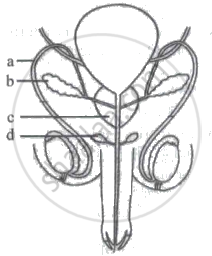
Identify the labels (a, b, c, and d) in the given diagram of the male reproductive system.
Spermatids are transformed into sperm by a process called ______.
Occurrence of Leydig’s cells and their secretion is ______.
ells of Leydig occur in ______.
Mark the odd one.
Mark the odd one.
In human males, the testes lie in the scrotum, because it helps in the
The given statement is incorrect. Rewrite the correct statement:
Seminiferous tubules secrete Testosterone.
Name these:
3 male accessory glands in humans.
The figure given ahead is an organ system of humans. Study the same and answer the following questions.
 |
- Identify the organ system.
- Label the guidelines 1 to 7.
- Write one important role of parts 3 and 6.
- Name the cells of part 1 that produce testosterone.
- What is the significance of the part 1 being located in a separate sac suspended outside the body?
In which anatomical region is the male reproductive system located?
Which three glands produce secretions that collectively form the seminal plasma?
What is the composition of semen in terms of its cellular and fluid components?
