Advertisements
Advertisements
Question
Define:
Periodic table
Advertisements
Solution
The periodic table is a tabular arrangement of elements in horizontal rows, called periods, and vertical columns, called groups, to classify elements and facilitate their systematic study.
APPEARS IN
RELATED QUESTIONS
How would the tendency to lose electrons change as we go from left to right across a period of the periodic table?
What is the fundamental difference in the electron configurations between the group 1 and group 2 elements?
An element barium has atomic number 56. Look up its position in the periodic table and answer the following question.
What will be the formula of its phosphate?
How will the tendency to gain electrons change as we go from left to right across a period? Why?
How does number of (i) valence electrons (ii) valency; vary on moving from left to right in the second period of a periodic table?
p-block is composed of groups 1 and 2.
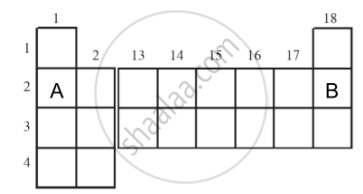
In the modern periodic table, the positions of 1 to 20 elements are shown here. Identify the elements A and B. Write their atomic number.
Distinguish between:
s-block - p-block
The longest period of the Modern Periodic Table is period.
“Hydrogen occupies a unique position in Modern Periodic Table”. Justify the statement.
