Advertisements
Advertisements
Question
Construct a triangle ABC with AB = 5.5 cm, AC = 6 cm and ∠BAC = 105°
Hence:
1) Construct the locus of points equidistant from BA and BC
2) Construct the locus of points equidistant from B and C.
3) Mark the point which satisfies the above two loci as P. Measure and write the length of PC.
Advertisements
Solution
1) Draw a line segment AB of length 5.5 cm.
2) Make an angle m∠BAX = 105° using a protractor
3) Draw an arc AC with radius AC = 6 cm on AX with centre at A.
4) Join BC.
Thus ΔABC is the required triangle.
a) Draw BR, the bisector of ∠ABC, which is the locus of points equidistant from BA and BC.
b) Draw MN, the perpendicular bisector of BC, which is the locus of points equidistant from B and C
c) The angle bisector of ∠ABC and the perpendicular bisector of BC meet at point P. Thus, P satisfies the above two loci.
Length of PC = 4.8 cm

APPEARS IN
RELATED QUESTIONS
Use ruler and compasses only for this question:
I. Construct ABC, where AB = 3.5 cm, BC = 6 cm and ABC = 60o.
II. Construct the locus of points inside the triangle which are equidistant from BA and BC.
III. Construct the locus of points inside the triangle which are equidistant from B and C.
IV. Mark the point P which is equidistant from AB, BC and also equidistant from B and C. Measure and records the length of PB.
O is a fixed point. Point P moves along a fixed line AB. Q is a point on OP produced such that OP = PQ. Prove that the locus of point Q is a line parallel to AB.
Construct a rhombus ABCD whose diagonals AC and BD are 8 cm and 6 cm respectively. Find by construction a point P equidistant from AB and AD and also from C and D.
In given figure 1 ABCD is an arrowhead. AB = AD and BC = CD. Prove th at AC produced bisects BD at right angles at the point M
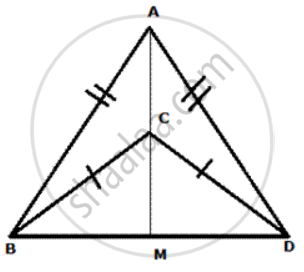
In Δ ABC, B and Care fixed points. Find the locus of point A which moves such that the area of Δ ABC remains the same.
Describe completely the locus of a point in the following case:
Midpoint of radii of a circle.
Describe completely the locus of a point in the following case:
Centre of a ball, rolling along a straight line on a level floor.
Construct a triangle ABC, such that AB= 6 cm, BC= 7.3 cm and CA= 5.2 cm. Locate a point which is equidistant from A, B and C.
Using ruler and compasses construct:
(i) a triangle ABC in which AB = 5.5 cm, BC = 3.4 cm and CA = 4.9 cm.
(ii) the locus of point equidistant from A and C.
(iii) a circle touching AB at A and passing through C.
Given ∠BAC (Fig), determine the locus of a point which lies in the interior of ∠BAC and equidistant from two lines AB and AC.
