Advertisements
Advertisements
Question
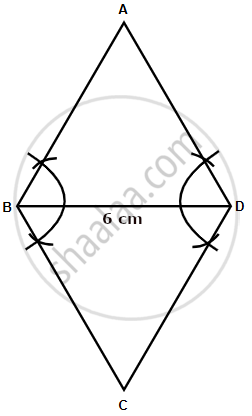
Construct a rhombus ABCD, when BD = 6 cm, ∠ABC = 120°.
Advertisements
Solution
Given:
- Diagonal BD = 6 cm
- ∠ABC = 120°
We need to construct a rhombus ABCD with these conditions.
Steps of construction:
- Draw line segment BD = 6 cm.
- Find the midpoint O of BD by drawing the perpendicular bisector of BD.
- Since ABCD is a rhombus, the diagonals bisect each other at right angles. So, draw a perpendicular bisector to BD at O.
- Let the length of diagonal AC be unknown. Denote AO = OC = x cm half of AC.
- At point B, we know ∠ABC = 120°. This angle is between sides AB and BC.
- Since ABCD is a rhombus, all sides are equal, so AB = BC = AD = CD.
- By properties of rhombus, the angle between adjacent sides corresponds to ∠ABC = 120°. Using this and the known diagonal BD, we can find the length of side AB and the half diagonal AO.
- Using the triangle ABO:
- BD is given BD = 6 cm
- O is midpoint of BD so BO = 3 cm
- At B, angle between side AB and BO can be related to the known angle 120°
- Using trigonometry or construction:
- Construct BD = 6 cm.
- At B, construct an angle of 120° angle ABC.
- From B, set AB = BC = length equal to be determined so that the figure closes and forms rhombus.
- Another approach is:
- Draw BD = 6 cm.
- At B, construct angle ABC = 120°.
- With B as center and radius equal to the length of side AB to be found, draw arc to intersect the perpendicular bisector of BD at points A and C.
- Since diagonals bisect each other at right angles, construct perpendicular bisector of BD; intersections with arcs give points A and C.
- Join points A and C.
- Join sides AB, BC, CD and DA.
Note: The length of AB can be calculated using geometric relations:
Using the law of cosines in triangle ABC:
AB = BC = s
∠ABC = 120°
Apart from this, using diagonal relations and given BD = 6 cm, AB can be found via formulas but since this is a construction, usually measurement or compass used.
Construct BD = 6 cm.
Construct the perpendicular bisector of BD and mark midpoint O.
At B, construct angle ABC = 120°.
Using compass and intersection of arcs from B and symmetry about O, locate points A and C.
Join A to B, B to C, C to D and D to A to complete rhombus ABCD with BD = 6 cm and ∠ABC = 120°.
Thus, ABCD is the required rhombus satisfying the given conditions.