English

Construct a Frequency Polygon for the Following Distribution: - Mathematics

Advertisements
Advertisements

Question

Construct a frequency polygon for the following distribution:

Class-intervals 0-4 4 - 8 8 - 12 12 - 16 16 - 20 20 - 24
Frequency 4 7 10 15 11 6
Graph
Sum
Advertisements

Solution

The frequency polygon is shown in the following figure
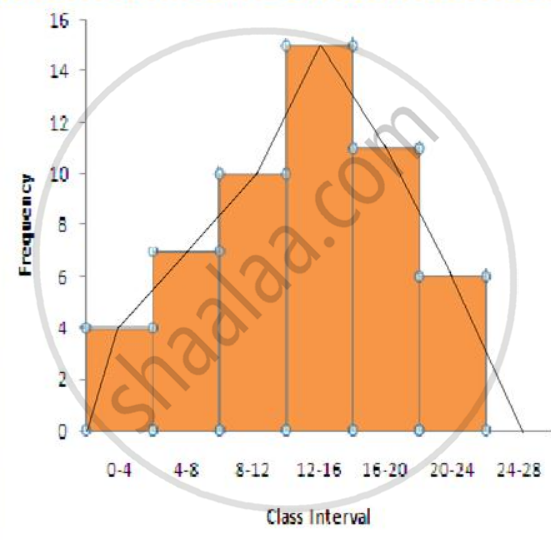
Steps:

(i) Drawing a histogram for the given data.

(ii) Marking the mid-point at the top of each rectangle of the histogram drawn.

(iii) Also, marking mid-point of the immediately lower class-interval and mid-point of the immediately higher class-interval.

(iv) Joining the consecutive mid-points marked by straight lines to obtain the required frequency polygon.

shaalaa.com
  Is there an error in this question or solution?
Chapter 18: Statistics - Exercise 18 (B) [Page 233]

APPEARS IN

Selina Concise Mathematics [English] Class 9 ICSE
Chapter 18 Statistics
Exercise 18 (B) | Q 1 | Page 233

RELATED QUESTIONS

The length of 40 leaves of a plant are measured correct to one millimetre, and the obtained data is represented in the following table:-

Length (in mm) Number of leaves
118 - 126 3
127 - 135 5
136 - 144 9
145 - 153 12
154 - 162 5
163 - 171 4
172 - 180
  1. Draw a histogram to represent the given data. [Hint: First make the class intervals continuous]
  2. Is there any other suitable graphical representation for the same data?
  3. Is it correct to conclude that the maximum number of leaves are 153 mm long? Why?

The runs scored by two teams A and B on the first 60 balls in a cricket match are given below:

Number of balls Team A Team B
1 - 6 2 5
7 - 12 1 6
13 - 18 8 2
19 - 24 9 10
25 - 30 4 5
31 - 36 5 6
37 - 42 6 3
43 - 48 10 4
49 - 54 6 8
55 - 60 2 10

Represent the data of both the teams on the same graph by frequency polygons.

[Hint: First make the class intervals continuous.]


A random survey of the number of children of various age groups playing in a park was found as follows:

Age (in years) Number of children
1 - 2 5
2 - 3 3
3 - 5 6
5 - 7 12
7 - 10 9
10 - 15 10
15 - 17 4

Draw a histogram to represent the data above.


Study the bar graph representing the number of persons in various age groups in a town shown in Fig. below. Observe the bar graph and answer the following questions:
(i) What is the percentage of the youngest age-group persons over those in the oldest age group?
(ii) What is the total population of the town?

(iii) What is the number of persons in the age group 60 - 65?
(iv) How many persons are more in the age-group 10 - 15 than in the age group 30 - 35?
(v) What is the age-group of exactly 1200 persons living in the town?
(vi) What is the total number of persons living in the town in the age-group 50 - 55?
(vii) What is the total number of persons living in the town in the age-groups 10 - 15 and 60 - 65?

(viii) Whether the population in general increases, decreases or remains constant with the increase in the age-group.


Explain the reading and interpretation of bar graphs.


The time taken, in seconds, to solve a problem by each of 25 pupils is as follows:
16, 20, 26, 27, 28, 30, 33, 37, 38, 40, 42, 43, 46, 46, 46, 48, 49, 50, 53, 58, 59, 60, 64, 52, 20
(a) Construct a frequency distribution for these data, using a class interval of 10 seconds.
(b) Draw a histogram to represent the frequency distribution.


The following table gives the distribution of IQ's (intelligence quotients) of 60 pupils of class V in a school:

IQ's: 125.5
to
13.25
118.5
to
125.5
111.5
to
118.5
104.5
to
111.5
97.5
to
104.5
90.5
to
97.5
83.5
to
90.5
76.5
to
83.5
69.5
to
76.5
62.5
to
69.5
No.
of pupils:
1 3 4 6 10 12 15 5 3 1

Draw a frequency polygon for the above data.


The monthly profits (in Rs.) of 100 shops are distributed as follows:

Profits per shop: 0-50 50-100 100-50 150-200 200-250 250-300
No. shops: 12 18 27 20 17 6

Draw a histogram for the data and show the frequency polygon for it.


Draw frequency polygons for each of the following frequency distribution: 

(a) using histogram

(b) without using histogram

C.I

10 - 30

30 - 50

50 - 70 70 - 90 90 - 110 110 - 130 130 - 150
ƒ  4 7 5 9 5 6 4

Harmeet earns Rs.50 000 per month. He a budget for his salary as per the following table:

Expenses Accommodation Food Clothing Travel Miscellaneous saving
Amount (Rs.) 12000 9000 2500 7500 4000 15000

Draw a bar graph for the above data.


Share
Notifications

Englishहिंदीमराठी


      Forgot password?
Use app×