Advertisements
Advertisements
Question
Compose your own limericks on an elephant, a peacock and a butterfly. Read it out to your class.
Advertisements
Solution
1. An elephant
There was a little elephant
To whom the river bank was forbidden.
But he went to the brink
Waiting for the crow to drink
And a bitter lesson when his flunk got bitten
2. A Peacock
“Joy is a peacock. Its beauty so rare
A rainbow of colors that vibrantly flares
After the rain, brightly they come out
Into a fan-like form uniquely it creates
Never forgot, this vision, joyfully it illuminates”!
3. Butterfly
A Spider awaits a butterfly
As he comes fluttering by
It’s caught in the silken trap
And straggles acts wings flap
Battling for survival under the blue skies
APPEARS IN
RELATED QUESTIONS
Find and discuss some examples of reports related to the given topic.
Bravery awards
When are folk dances and folk music usually performed?
You are visiting the primary school where you studied classes I to IV, after six years. You get a chance to go to your standard two classrooms and you are permitted to sit at the same place where you used to sit.
What would you remember?
You are visiting the primary school where you studied classes I to IV, after six years. You get a chance to go to your standard two classrooms and you are permitted to sit at the same place where you used to sit.
Describe your feelings at that time.
Deliver a short speech for about five minutes on the following.
Think of a situation where all the trees can speak. What will they talk about?
Figures of speech
Assonance: Repetition of similar vowel sounds in the neighbouring words
(e.g.) ‘T is the prettiest little parlour that ever you did spy; Pick out one more instance from the poem.
Mock anchoring for annual day celebration.
“Where does Helen live?”
Jim wants to know where ______.
Mathew is a very busy man.
Can you do an art work or a craft work on your own?
Role-play the conversation in the class.
| Manoj: | Hi Priya! How are you? |
| Priya: | I am fine, and what about you? |
| Manoj: | I am fine too. What are you doing in this early morning? |
| Priya: | I am taking care of my garden. |
| Manoj: | Oh! What a beautiful garden it is! |
| Priya: | It is beautiful as I work every day in it. |
| Manoj: | Who helps you in your work? |
| Priya: | I do it myself. It is my hobby and I have cultivated vegetables. |
| Manoj: | Oh! that’s nice. How long have you been doing this? |
| Priya: | I have been doing this for ...... |
| Manoj: | .................................... |
| Priya: | .................................... |
| Manoj: | .................................... |
| Priya: | .................................... |
| Manoj: | .................................... |
Take something from your school bag. Describe it in three sentences. Ask the class to find out the thing you have described.
Sherlyn receives a postcard from her friend Pushpa who is holidaying in Sri Lanka. She calls her friend Galen and tells him what Pushpa has written. Help her by filling in the blanks, using reported speech.
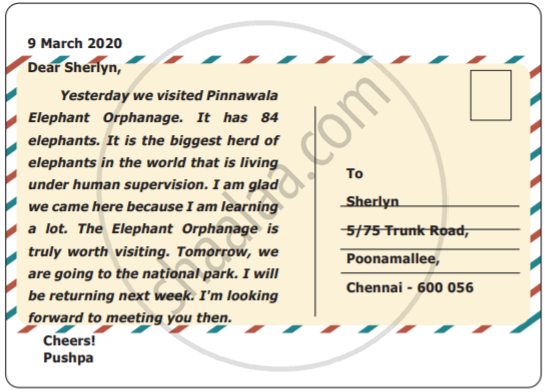
Hello, Galen Today I received a postcard from Pushpa. Remember I had told you that She has gone to Sri Lanka on a holiday? Well, she has written from Colombo. She has written that ____________ Orphanage. It ____________ elephants. She said that it is the biggest herd of elephants in the world that is living under human supervision. She also added that she ____________ because ____________. The Elephant Orphanage ____________ . She said that ____________ national park. She ____________ next week and added that ____________ then.
Match the rhyming words.
| 1. | tall | best |
| 2. | song | all |
| 3. | rack | along |
| 4. | rest | sack |
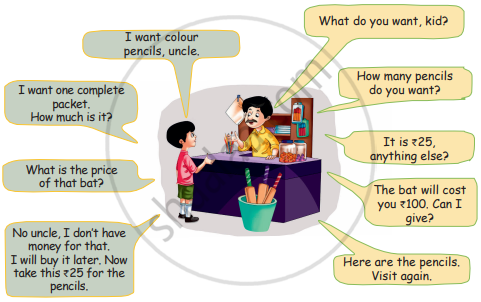
See how they speak at this situation and practise as if you were in that situation.
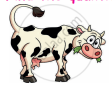
Find the qualities of these animals from the passage.
A little
red hen had some wheat seeds. “Will you help me sow this seed?” asked the hen,“No” replied the selfish dog. Then the hen did it by herself. The seeds grew into a field of wheat. “Will you help me reap the wheat?” asked the hen, “No” replied the sleepy cat. She did it by herself. “Will you help me grind the wheat?” asked the hen, “No” replied the noisy duck. She did it by herself. “Will you help me make a bread?” asked the hen, “No” replied the lazy cow. She made the bread by herself. “Will you all help me eat this bread?” asked the hen, “Yes” replied everyone,“No” said the hen.
 |
 |
 |
 |
In groups of five, discuss what you enjoy doing alone and what you like doing in a group. Now prepare a list as shown below.
| Things I like doing alone | Things I like doing in a group |
In your family, what activities are done individually and as a group?
| My mother decides | |
| My father decides | |
| I decide | |
| We decide |
Look at the picture again. Describe the picture.

Some letter are missing in each word.
tr __ __ s
Some letter are missing in each word.
t ______ se
Now add more words with and and put them inside the bubbles.

How could Alice have got into the garden?
Where did the tip of the tongue touch?
Did you hear what your tongue did?
Have you seen
- a hippopotamus in a hat?
- a hen in a beehive?
- a helicopter with hair?
- a horse drink honey?
‘Forgetfulness is the beginning of happiness’- Do you agree or disagree? Discuss in class.
