Advertisements
Advertisements
Question
Complete the table below.
| Radius (r) | Diameter (d) | Circumference (c) |
| ...... | 28 cm | ...... |
Advertisements
Solution
| Radius (r) | Diameter (d) | Circumference (c) |
| 14 cm | 28 cm | 88 cm |
Explanation:
Diameter (d) = 28 cm
Radius (r) = `d/2 = 28/2` = 14 cm
Circumference (c) = πd
= `22/7 xx 28`
= 88 cm
RELATED QUESTIONS
The radius of a circle is 7 cm. find the circumference of the circle.
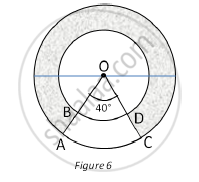
In Fig. 6, find the area of the shaded region, enclosed between two concentric circles of radii 7 cm and 14 cm where ∠AOC = 40°. (use `pi = 22/7`)
In a circle of radius 10.5 cm, the minor arc is one-fifth of the major arc. Find the area of the sector corresponding to the major arc.
The radius of a circular garden is 100 m. There is a road 10 m wide, running all around it. Find the area of the road and the cost of levelling it at Rs 20 per m2. [Use π = 3.14.]
The diameter of a wheel is 1.4m. How many revolutions does it make in moving a distance of 2.2 kms?
The diameter of a right circular cylinder is 12 m and the slant height is 10 m. Find its curved surface area and the total surface area .
A wheel has a diameter of 84 cm. Find how many completer revolutions must it make to cover 3.168 km.
The circumference of a circle exceeds its diameter by 18 cm. find the radius of the circle.
Diameters of different circles are given below. Find their circumference (Take π = `22/7`)
d = 56 m
The area of a circle whose circumference is 22 cm, is ____________.
