Advertisements
Advertisements
Question
Circumference ‘C’ of a circle can be found by multiplying diameter ‘d’ with ______.
Advertisements
Solution
Circumference ‘C’ of a circle can be found by multiplying diameter ‘d’ with π.
Explanation:
∵ Circumference = 2πr
Since, diameter (d) = 2r
So, C = π × d
Hence, π is the answer.
APPEARS IN
RELATED QUESTIONS
Four cows are tethered at four corners of a square plot of side 50m, so that’ they just cant reach one another. What area will be left ungrazed.
Choose the correct alternative answer for the following question.
Three equal circles, each of radius 6 cm, touch one another as shown in the figure. Find the area of enclosed between them. [Take π = 3.14 and `sqrt(3) = 1.73`.]
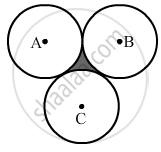
The perimeter of a sector of a circle of radius 5.6 cm is 27.2 cm. Find the area of the sector.
The radius of the circle is given below; find the area.
28 cm
A conical tent with a capacity of 600 m3 stands on a circular base of area 160 m2 Find in m2 the area of the canvas.
Draw the circumcircle of Δ PMT in which PM = 5.4, P = 60°, M = 70°.
The diameter of two circles are 28 cm and 24 cm. Find the circumference of the circle having its area equal to sum of the areas of the two circles.
The area between the circumference of two concentric circles is 2464cm2. If the inner circle has a circumference of 132cm, calculate the radius of the outer circle.
A 4.2m wide road surrounds a circular plot whose circumference is 176m. Find the cost of paving the road at Rs.75per m2.
