Advertisements
Advertisements
Question
At the time of short circuit, the electric current in the circuit ______.
Options
vary continuously
does not change.
reduces substantially
increases heavily
Advertisements
Solution
At the time of the short circuit, the electric current in the circuit increases heavily.
Explanation:
A short circuit occurs when an electric current escapes the normal load via a low-resistance pathway (usually caused by direct contact between the live and neutral wires). Ohm’s Law (I = V/R) states that current (I) is inversely proportional to resistance. Short circuits lower resistance to near-zero levels, resulting in a sudden and significant rise in current. This quick surge can generate a lot of heat, which could start a fire or damage electrical components.
APPEARS IN
RELATED QUESTIONS
In 10 s, charge of 25 C leaves a battery, and 200 J of energy are delivered to an outside circuit a result.
What is the p.d. across the battery?
Draw a circuit diagram showing two electric lamps connected in parallel together with a cell and a switch that works both lamps. Mark an â’¶ on your diagram to show where an ammeter should be placed to measure the current.
Consider the circuit given below when A, B and C are three identical light bulbs of constant resistance. 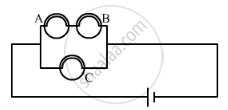
(a) List the bulbs in order of increasing brightness.
(b) If C burns out, what will be the brightness of A now compared with before?
(c) If B burns out instead, what will be the brightness of A and C compared with before?
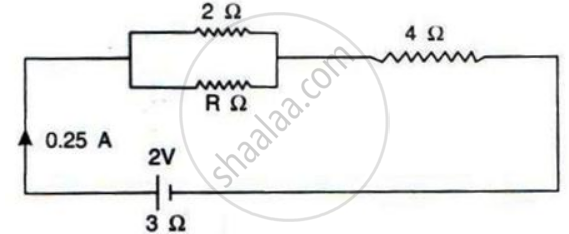
The following circuit diagram shows three resistors 2 Ω, 4 Ω and R Ω connected to a battery of e.m.f 2V and internal resistance 3 Ω. If the main current of 0.25 A flows through the circuit, find:
- the p.d. across the 4 Ω resistors,
- the p.d. across the internal resistance of the cell,
- the p.d. across the R Ω or 2 Ω resistors, and
- the value of R.
Complete the following sentence:
Fuse wire has a ............ Melting point and it is made of an alloy of ......... and if the current in a circuit rises too high, the fuse wire ...........
Three heaters each rated 250 W, 100 V are connected in parallel to a 100 V supply. The resistance of each heater
Two electric bulbs rated 100 W; 220 V and 60 W; 220 V are connected in parallel to electric mains of 220 V. Find the current drawn by the bulbs from the mains.
How should the electric lamps in a building be connected?
What does the direction of current convey?
