Advertisements
Advertisements
Question
Can there be a good reason behind speaking when everybody else is silent?
Advertisements
Solution
Yes, sometimes people do not dare to raise Voice against the wrong happening. But a rebel cannot tolerate unfair things and raises voice against it. If nobody dares to speak, the once who do wrong are encouraged to do so ever again.
RELATED QUESTIONS
Discuss in pair and answer question below in a short paragraph (30 − 40 words.
What did George and Harris offer to pack and why?
Thinking about the Poem
Is the poet now a child? Is his mother still alive?
Why does the author say that Iswaran seemed to more than make up for the absence of a TV in Mahendra’s living quarters?
Working in small groups of 4−5 students, go back over the two passages on Santosh Yadav and Maria Sharapova and complete the table given below with relevant phrases or sentences.
|
Points of Comparison/Contrast |
Santosh Yadav | Maria Sharapova |
|
1. Their humble beginning |
|
|
|
2 . Their parents’ approach |
|
|
|
3. Their will power and strong desire to succeed |
|
|
|
4. Evidence of their mental toughness |
|
|
|
5. Their patriotism |
|
Now, it is your turn. Write and produce your own radio programme. You will need to select your own content. The following are some ideas. You are free, of course, to add your own ideas. Remember, the programme must be in English.
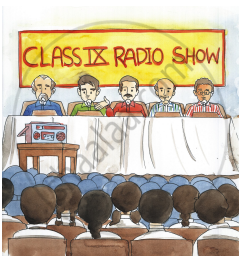
- News stories: about people in your class, about school, about sports (school and local), about the local community
- Comedy: jokes, short plays
- Interviews: with teachers, with exstudents of your school, with a Class IX student who has recently done something very interesting
- Games: general knowledge quiz, panel game, word game
- Advertisements: for shops/industries in the local community, things ‘for sale’ and ‘wanted’ by students
- Local sites: monuments/sites of historical importance and of tourist interest
- Special reports: e.g. safety at school, examination results, school uniform, school assemblies
- Interesting people: role-play interviews with film stars, sports personalities, TV personalities, etc.
- Entertainment reviews: music, films, videos, books, etc.
- Plays
- Songs with lyrics
- Speeches on important personalities
- Tele conference video conference with students, teachers, experts
Here's a glimpse of a naughty child whose life is full of fun and frolic .
One of the reasons why Tom's mind had drifted away from ita secret troubles was that it bad found a new and weighty matter to interest itself about. Becky Thatcher had stopped coming to school. Tom bad struggled with his pride a few days and tried to "whistle her down the wind," but failed. He began to find himself hanging around her father's house all night and feeling very miserable. She was ill. What if she should die! There was distraction in the thought. Tom Sawyer no longer took an interest in war, nor even in piracy. The charm of life was gone; there was nothing but dreariness left. He put his hoop away, and his bat; there was no joy in them any more. His aunt was concerned. She began to try all manners of remedies on him. She was one of those people who are Infatuated with patent medicines and all new-fangled methods of producing health or mending it. She was an inveterate experimenter in these things. When something fresh in this line came out, she was in a fever, right away, to try it; not on herself, for she was never ailing, but on anybody else that came handy.
2. She tried every remedy she could. Yet, not with standing all this, the boy grew more and more melancholy and pale and dejected. She added hot baths, sitz baths, shower baths, and plunges. The boy remained as dismal as a hearse. She began to assist the boy with a slim oatmeal diet and blister-plaster&. She calculated his capacity as she would judge and filled him up every day with quack cure-alls.
3. Tom had become indifferent to persecution by this time. This phase filled the old lady's heart with consternation. This indifference must be broken up at any cost. Now she heard of Pain-killer for the first time. She ordered a lot at once. She tasted it and was filled with gratitude. It was simply fire in a liquid form. She dropped the water treatment and everything else, and pinned her faith on Pain-killer. She gave Tom a teaspoonful and watched with the deepest anxiety for the result. Her troubles were instantly at rest, her soul at peace again; for the 'indifference' was broken up. The boy could not have shown a wilder, heartier interest, if she had built a fire under him.
4. Tom felt that it was time to wake up; this sort of life might be romantic enough, in his blighted condition, but it was getting to have too little sentiment and too much distracting variety about it. So he thought over various plans for relief and finally hit upon that of professing to be fond of Pain-killer. He asked for it so often that he became a nuisance and his aunt ended up by telling him to help himself and quit bothering her. If it had been Sid, she would have had no misgivings to alloy her delight; but since it was Tom, she watched the bottle clandestinely. She found that the medicine did really diminish, but it did not occur to her that the boy was mending the health of a crack in the sitting-room floor with it.
5. One day Tom was in the act of dosing the crack when his aunt's yellow cat came along, purring, eyeing the teaspoon avariciously and begging for a taste. Tom said: "Peter, now you've asked for it, and I'll give it to you, because there ain't anything mean about me; but if you find you don't like it, you mustn't blame anybody but your own self."
6. Tom pried his mouth open and poured down the Pain-killer. Peter sprang a couple of yards in the air, and then delivered a war-whoop and set off round and round the room, banging against furniture, upsetting flower-pots, and making general havoc. Next he rose on his hind feet and pranced around, in a frenzy of enjoyment, with his head over his shoulder and his voice proclaiming his unappeasable happiness. Then he went tearing around the house again spreading chaos and destruction in his path. Aunt Polly entered in time to see him throw a few double summersaults, deliver a final mighty hurrah, and sail through the open window, carrying the rest of the flower-pots with him. The old lady stood petrified with astonishment, peering over her glasses; Tom lay on the floor hysterical with laughter.
"Tom, what on earth ails that cat?"
"I don't know, aunt," gasped the boy.
7. The old lady was bending down, Tom watching, with interest emphasized by anxiety. Too late he divined her 'drift'. The handle of the telltale teaspoon was visible under the sofa. Aunt Polly took it, held it up. Tom winced, and dropped his eyes. Aunt Polly raised him by the usual handle - his ear - and cracked his head soundly with her thimble.
"Now, sir, what did you want to treat that poor dumb beast so, for?"
"I done it out of pity for him - because he hadn't any aunt."
"Hadn't any aunt! -you numskull. What has that got to do with it?"
"Heaps. Because if he'd had one, she'd a burnt him out herself! She'd a roasted his bowels out of him 'thout any more feeling than if he was a human!"
Tom looked up in her face with just a perceptible twinkle peeping through his gravity.
"I know you was meaning for the best, aunty, and so was I with Peter. It done him good, too. I never see him get around so-"
Six humans trapped by happenstance
In black and bitter cold.
Each one possessed a stick of wood,
Or so the story's told.
Their dying fire in need of logs;
The first man held his back.
For on the faces around the fire,
He noticed one was black.
Read the lines given above and answer the question that follow:
What is suggested by the use of the word trapped?
Old Kaspar took it from the boy,
Who stood expectant by;
And then the old man shook his head,
And,with a natural sigh,
"Tis some poor fellow's skull," said he,
"Who fell in the great victory.
"I find them in the garden,
For there's many here about;
And often when I go to plough,
The ploughshare turns them out!
For many thousand men,"said he,
"Were slain in that great victory."
Read the lines given above and answer the question that follow.
Why does the poet use a skull?
The boy looked up. He took his hands from his face and looked up at his teacher. The light from Mr. Oliver’s torch fell on the boy’s face, if you could call it a face. He had no eyes, ears, nose or mouth. It was just a round smooth head with a school cap on top of it.
And that’s where the story should end, as indeed it has for several people who have had similar experiences and dropped dead of inexplicable heart attacks. But for Mr. Oliver, it did not end there. The torch fell from his trembling hand. He turned and scrambled down the path, running blindly through the trees and calling for help. He was still running towards the school buildings when he saw a lantern swinging in the middle of the path. Mr. Oliver had never before been so pleased to see the night watchman. He stumbled up to the watchman, gasping for breath and speaking incoherently.
What is it, Sahib? Asked the watchman, has there been an accident? Why are you running?
I saw something, something horrible, a boy weeping in the forest and he had no face.
No face, Sahib?
No eyes, no nose, mouth, nothing.
Do you mean it was like this, Sahib? asked the watchman, and raised the lamp to his own face. The watchman had no eyes, no ears, no features at all, not even an eyebrow. The wind blew the lamp out and Mr. Oliver had his heart attack.
Read the extract given below and answer the question that follow.
What was Mr Oliver’s reaction when he saw the faceless boy? Whom did he stumble into?
The women came out on the shore, and made for the stepping—?stones. They had plenty to laugh and bicker about, as they approached the river in a noisy crowd. They girded up their skirts, so as to jump from stone to stone, and they clanked their sickles and forks together over their shoulders to have ease of movement. They shouted their quarrels above the gush of the river. Noise frightens crocodiles. The big mugger did not move, and all the women crossed in safety to the other bank. Here they had to climb a steep hillside to get at the grass, but all fell to with a will, and sliced away at it wherever there was foothold to be had. Down below them ran the broad river, pouring powerfully out from its deep narrow pools among the cold cliffs and shadows, spreading into warm shallows, lit by kingfishers. Great turtles lived there, and mahseer weighing more than a hundred pounds. Crocodiles too. Sometimes you could see them lying out on those slabs of clay over there, but there were none to be seen at the moment.
Read the extract given below and answer the question that follow.
Why did they shout louder than the sound of the water?
I was in for a surprise. When the time came for the broad-jump trials, I was startled to see a tall boy hitting the pit at almost 26 feet on his practice leaps! He turned out to be a German named Luz Long. 1 was told that Hitler hoped to win the jump with him. I guessed that if Long won, it would add some new support to the Nazis’ “master race” (Aryan superiority) theory. After all, I am a Negro. Angr about Hitler’s ways, 1 determined to go out there and really show Der Fuhrer and his master race who was superior and who wasn’t. An angry athlete is an athlete who will make mistakes, as any coach will tell you. I was no exception. On the first of my three qualifying jumps, I leaped from several inches beyond the takeoff board for a foul. On the second jump, I fouled even worse. “Did I come 3,000 miles for this?” I thought bitterly. “To foul out of the trials and make a fool of myself ?” Walking a few yards from the pit, 1 kicked disgustedly at the dirt.
Read the extract given below and answer the question that follow.
Why did Owens become hot under the collar before the trials?
Then, trying to hide my nervousness, I added, “How are you?”
“I’m fine. The question is: How are you?“
“What do you mean?” 1 asked “Something must be eating you,” he said—proud the way foreigners are when they’ve mastered a bit of American slang. “You should be able to qualify with your eyes closed.”
“Believe me, I know it,” I told him—and it felt good to say that to someone.
For the next few minutes we talked together. I didn’t tell Long what was “eating” me, but he seemed to understand my anger, and he took pains to reassure me. Although he’d been schooled in the Nazi youth movement, he didn’t believe in the Aryan-supremacy business any more than I did. We laughed over the fact that he really looked the part, though. An inch taller than I, he had a lean, muscular frame, clear blue eyes, blond hair and a strikingly handsome, chiseled face. Finally, seeing that I had calmed down somewhat, he pointed to the take-off board.
“Look,” he said. “Why don’t you draw a line a few inches in back of the board and aim at making your take-off from there? You’ll be sure not to foul, and you certainly ought to jump far enough to qualify. What does it matter if you’re not first in the trials? Tomorrow is what counts.”
Read the extract given below and answer the question that follow.
Describe Luz Long.
What do we learn from the lives of great men? What is the final message of the poem ? Give one reason why the poem appeals to you.
Narrate the tale of two birds in your own words.
The shepherd hadn’t been to school because
Choose the right answer.
How did the monkey save himself?
What does the poet refer to as ‘they’ in the following stanza?
"I saw a snake and ran away Some snakes are
dangerous, they say"
Multiple Choice Question:
What does the phrase pick their noses’ mean?
Multiple Choice Question:
What does the expression “They pinched the chocolate-flakes’ mean?
Why does the rebel choose to Wear fantastic Clothes?
