Advertisements
Advertisements
Question
Answer the following question.
What happened one Sunday when the lady was going to her sister’shouse? What did the lady do? What was the bear’s reaction?
Advertisements
Solution
One Sunday when the lady was going to her sister’s house, she saw a bear coming along at full speed. Thinking that he was her pet, the lady got very angry. Being already late for lunch, she scolded him and told him to go back. She saw that he had even lost his new collar. This made her angrier, and she hit him on his nose with her parasol. The parasol broke in two. The bear opened his mouth several times as if he wanted to say something, and then it turned around and went on its way.
RELATED QUESTIONS
Answer of these question in a short paragraph (about 30 words).
How does he describe the old kind of teachers?
Discuss in pairs and answer question below in a short paragraph (30 − 40 words.
How did George and Harris react to this? Did Jerome like their reaction?
When you were a young child, did your mother tuck you in, as the poet’s did?
The most important thing we've learned,
So far as children are concerned,
Is never, NEVER, NEVER let
Them near your television set-----
Or better still, just don't install
The Idiotic thing at all.
In almost every house we've been,
we've watched them gaping at the screen
They loll and slop and lounge about,
And stare until their eyes pop out.
(Last week in someone's place we saw
A dozen eyeballs on the floor.
They sit and stare and stare and sit
Until they're hypnotised by it,
Until they're absolutely drunk
With all that shocking ghastly junk.
Read the lines given above and answer the question given below.
Name some of the things that the poet has seen in house which have televisions.
'All right!' you 'll cry.'All right!' you'll say,
'But if we take the set away,
What shall we do to entertain
Our darling children?Please explain!'
We'll answer this by asking you,
'What used the darling ones to do?
'How used they keep themselves contented
Before this monster was invented?'
Have you forgotten? Don't you know?
We'll say it very loud and slow:
THEY ... USED ... TO ... READ! They'd READ and READ,
AND READ and READ, and then proceed
To READ some more. Great Scott! Gadzooks!
One half their lives was reading books!
The nursery shelves held books galore!
Books cluttered up the nursery floor!
And in the bedroom, by the bed,
More books were waiting to be read!
Read the lines given above and answer the question given below.
What should be done to keep the children occupied?
The blocks were all lined up for those who would use them
The hundred-yard dash and the race to be run
These were nine resolved athletes in back of the starting line
Poised for the sound of the gun.
The signal was given, the pistol exploded
And so did the runners all charging ahead
But the smallest among them,he stumbled and staggered
And fell to the asphalt instead.
He gave out a cry in frustration and anguish
His dreams ands his efforts all dashed in the dirt
But as sure I'm standing here telling this story
The same goes for what next occurred.
Read the lines given above and answer the following question:
How many competitors were there for the events?
It was my business to cross the bridge, explore the bridge head 3 beyond and find out to what point the enemy had advanced. I did this and returned over the bridge. There were not so many carts now and very few people on foot, but the old man was still there.’’Where do you come from?” I asked him.
“From San Carlos,” he said, and smiled.
That was his native town and so it gave him pleasure to mention it and he smiled.
“I was taking care of animals,” he explained.
“Oh,” I said, not quite understanding.
“Yes,” he said, “I stayed, you see, taking care of animals. I was the last one to leave the town of San Carlos.”
He did not look like a shepherd nor a herdsman and I looked at his black dusty clothes and his gray dusty face and his steel rimmed spectacles and said, “What animals were they?”
“Various animals,” he said, and shook his head. “I had to leave them.”
Read the extract given below and answer the question that follow.
What is the narrator’s job?
Of the seven hundred villages dotting the map of India, in which the majority of India’s five hundred million live, flourish and die, Kritam was probably the tiniest, indicated on the district survey map by a microscopic dot, the map being meant more for the revenue official out to collect tax than for the guidance of the motorist, who in any case could not hope to reach it since it sprawled far from the highway at the end of a rough track furrowed up by the iron-hooped wheels of bullock carts. But its size did not prevent its giving itself the grandiose name Kritam, which meant in Tamil coronet or crown on the brow of the subcontinent. The village consisted of fewer than thirty houses, only one of them built from brick and cement and painted a brilliant yellow and blue all over with
gorgeous carvings of gods and gargoyles on its balustrade, it was known as the Big House. The other houses, distributed in four streets, were generally of bamboo thatch, straw, mud and other unspecified material. Muni’s was the last house in the fourth street, beyond which stretched the fields. In his prosperous days Muni had owned a flock of sheep and goats and sallied forth every morning driving the flock to the highway a couple of miles away.
Read the extract given below and answer the question that follow.
How many houses were there in the village?
Abbu Khan said, “No more goats in my house ever again.” Then he changed his mind. Why?
What do you think the mechanical hand was trying to do?
The music master is making lovely music. Read aloud the sentence in the text that expresses this idea.
Find in the poem an antonym (a word opposite in meaning) of the following word
grow
Now write the story in your own words. Give it a title.
How does an electric fan managed to throw so much air when it is switched on?
What does the child’s mother say about snakes?
Use the clues given below to complete this crossword puzzle.
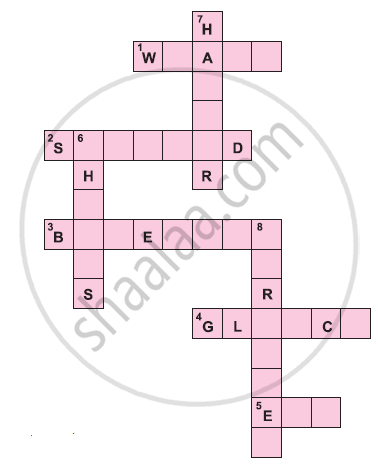
Across
1. very tired
2. had an angry look on the face
3. short trousers
4. a fault in a machine that prevents it from working properly
5. a small and naughty boy-fairy
Down
6. work that must be done every day, often boring
7. a basket with a lid
8. gave a short, high-pitched cry
What does the writer say about the friendship between man and dog?
How does the poet describe the facts/journey or antics of a kite in the sky?
What does the rebel do?
“You should be able to qualify with your eyes closed.” Who said these words and to whom?
