Advertisements
Advertisements
Question
Calculate the quantity of heat produced in a 20 Ω resistor carrying 2.5 A current in 5 minutes.
Advertisements
Solution
Given: \[R=20\ \Omega\]
\[I=2.5\text{A}\]
\[t=5\times60=300\ \text{s}\]
Formula: \[H=I^{2}Rt\]
\[H=(2.5)^{2}\times20\times300\]
\[H=(6.25)\times20\times300\]
∴ \[H=37{,}500\ \text{J}\]
RELATED QUESTIONS
The values of current (I) flowing through a given resistor of resistance (R), for the corresponding values of potential difference (V) across the resistor are as given below:
| V (volts) | 0.5 | 1.0 | 1.5 | 2.0 | 2.5 | 3.0 | 4.0 | 5.0 |
| I (amperes) | 0.1 | 0.2 | 0.3 | 0.4 | 0.5 | 0.6 | 0.8 | 1.0 |
Plot a graph between current (I) and potential difference (V) and determine the resistance (R) of the resistor.
The p.d. across a lamp is 12 V. How many joules of electrical energy are changed into heat and light when:
a charge of 1 C passes through it?
A current of 5 amperes flows through a wire whose ends are at a potential difference of 3 volts. Calculate the resistance of the wire.
Why do electricians wear rubber hand gloves while working with electricity?
A current of 1.6 mA flows through a conductor. If charge on an electron is –1.6 × 10⁻¹⁹ coulomb, find the number of electrons that will pass each second through the cross section of that conductor.
A current of 0.2 A flows through a wire whose ends are at a potential difference of 15 V. Calculate:
(i) The resistance of the wire, and
(ii) The heat energy produced in 1 minute.
The voltage across a 3Ω resistance is 6 V. How large is the current? What is
the resistance of a filament lamp when a voltage of 3 V across it causes a
current of 0.5 A?
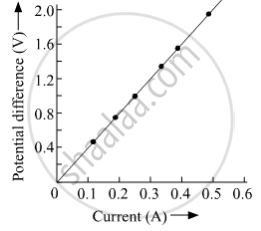
A V-I graph for a nichrome wire is given below. What do you infer from this graph? Draw a labelled circuit diagram to obtain such a graph.
Point out two differences between e.m.f. and potential difference as applied to electric circuits.
Which of the following represents voltage?
