Advertisements
Advertisements
Question
By what number should each of the following numbers be multiplied to get a perfect square? Also, find the number whose square is the new number.
4056
Advertisements
Solution
4056 = 2 x 2 x 2 x 3 x 13 x 13
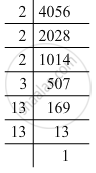
Grouping them into pairs of equal factors:
4056 = (2 x 2) x (13 x 13) x 2 x 3
The factors at the end, 2 and 3 are not paired. For a number to be a perfect square, each prime factor has to be paired. Hence, 4056 must be multiplied by 6 (2 x 3) for it to be a perfect square.
The new number would be (2 x 2) x (2 x 2) x (3 x 3) x (13 x 13).
Furthermore, we have:
(2 x 2) x (2 x 2) x (3 x 3) x (13 x 13) = (2 x 2 x 3 x 13) x (2 x 2 x 3 x 13)
Hence, the number whose square is the new number is:
2 x 2 x 3 x 13 = 156
RELATED QUESTIONS
Which of the following numbers are perfect squares?
484
Which of the following numbers are perfect squares?
941
Which of the following numbers are perfect square?
111
Which of the following numbers are perfect square?
121
By what numbers should each of the following be divided to get a perfect square ? Also, find the number whose square is the new number.
16562
The following number is not perfect square. Give reason.
45743
The following number is not perfect square. Give reason.
8948
When a square number ends in 6, its square root will have 6 in the unit’s place
These number of boxes is equal to one square number. The number is _______________
What is next square number of 49?
