Advertisements
Advertisements
प्रश्न
By what number should each of the following numbers be multiplied to get a perfect square? Also, find the number whose square is the new number.
4056
Advertisements
उत्तर
4056 = 2 x 2 x 2 x 3 x 13 x 13
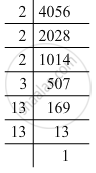
Grouping them into pairs of equal factors:
4056 = (2 x 2) x (13 x 13) x 2 x 3
The factors at the end, 2 and 3 are not paired. For a number to be a perfect square, each prime factor has to be paired. Hence, 4056 must be multiplied by 6 (2 x 3) for it to be a perfect square.
The new number would be (2 x 2) x (2 x 2) x (3 x 3) x (13 x 13).
Furthermore, we have:
(2 x 2) x (2 x 2) x (3 x 3) x (13 x 13) = (2 x 2 x 3 x 13) x (2 x 2 x 3 x 13)
Hence, the number whose square is the new number is:
2 x 2 x 3 x 13 = 156
संबंधित प्रश्न
Which of the following numbers are perfect square?
16
Which of the following numbers are perfect square?
32
Which of the following numbers are perfect squares?
36
Which of the following numbers are perfect square?
81
Using prime factorization method, find which of the following numbers are perfect square?
2916
Using prime factorization method, find which of the following numbers are perfect square?
3549
Show that the following number is not perfect square:
4058
196 is the square of ______.
The square of every natural number is always greater than the number itself.
How many square metres of carpet will be required for a square room of side 6.5 m to be carpeted.
