Advertisements
Advertisements
Question
Briefly explain the elementary particles present in nature.
Advertisements
Solution
- An atom has a nucleus surrounded by electrons and the nucleus is made up of protons and neutrons. Till 1960s, it was thought that protons, neutrons and electrons are fundamental building blocks of matter.
- In 1964, physicists Murray Gellman and George Zweig theoretically proposed that protons and neutrons are not fundamental particles; in fact they are made up of quarks. These quarks are now considered elementary particles of nature. Electrons are fundamental or elementary particles because they are not made up of anything.
- In the year 1968, the quarks were discovered experimentally by Stanford Linear Accelerator Centre (SLAC), USA. There are six quarks namely, up, down, charm, strange, top and bottom and their antiparticles. All these quarks have fractional charges.
For example, a charge of up quark is +`2/3`e and that of down quark is - `1/3`e. - According to the quark model, a proton is made up of two up quarks and one down quark, and a neutron is made up of one up quark and two down quarks.
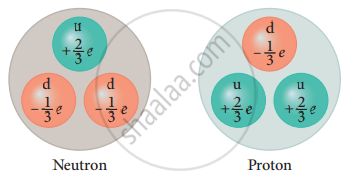
Constituents of nucleons - The study of elementary particles is called particle physics and it is an active area of research even now.
- Till date, more than 20 Nobel prizes have been awarded in the field of particle physics.
APPEARS IN
RELATED QUESTIONS
In a photon-electron collision ______.
(A) only total energy is conserved.
(B) only total momentum is conserved.
(C) both total energy and total momentum are conserved.
(D) both total momentum and total energy are not conserved
Write notes on Nuclear fusion
Free 238U nuclei kept in a train emit alpha particles. When the train is stationary and a uranium nucleus decays, a passenger measures that the separation between the alpha particle and the recoiling nucleus becomes x in time t after the decay. If a decay takes place when the train is moving at a uniform speed v, the distance between the alpha particle and the recoiling nucleus at a time t after the decay, as measured by the passenger will be
Consider the fusion in helium plasma. Find the temperature at which the average thermal energy 1.5 kT equals the Coulomb potential energy at 2 fm.
Why nuclear fusion reaction is also called thermo-nuclear reaction?
Explain in detail the four fundamental forces in nature.
The curve of binding energy per nucleon as a function of atomic mass number has a sharp peak for helium nucleus. This implies that helium nucleus is ______.
In the fusion reaction \[^{2}_{1}H + ^{2}_{1}H \rightarrow ^{3}_{2}He + n\] which products are formed and how much energy is released?
Why can thermonuclear fusion in stars occur even when the average thermal energy of particles is lower than required?
What is expected to happen to the Sun after the hydrogen in its core is exhausted?
