Advertisements
Advertisements
प्रश्न
Briefly explain the elementary particles present in nature.
Advertisements
उत्तर
- An atom has a nucleus surrounded by electrons and the nucleus is made up of protons and neutrons. Till 1960s, it was thought that protons, neutrons and electrons are fundamental building blocks of matter.
- In 1964, physicists Murray Gellman and George Zweig theoretically proposed that protons and neutrons are not fundamental particles; in fact they are made up of quarks. These quarks are now considered elementary particles of nature. Electrons are fundamental or elementary particles because they are not made up of anything.
- In the year 1968, the quarks were discovered experimentally by Stanford Linear Accelerator Centre (SLAC), USA. There are six quarks namely, up, down, charm, strange, top and bottom and their antiparticles. All these quarks have fractional charges.
For example, a charge of up quark is +`2/3`e and that of down quark is - `1/3`e. - According to the quark model, a proton is made up of two up quarks and one down quark, and a neutron is made up of one up quark and two down quarks.
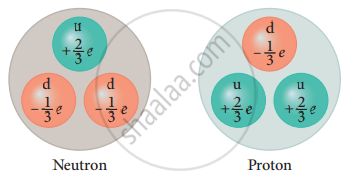
Constituents of nucleons - The study of elementary particles is called particle physics and it is an active area of research even now.
- Till date, more than 20 Nobel prizes have been awarded in the field of particle physics.
APPEARS IN
संबंधित प्रश्न
Calculate the height of the potential barrier for a head on collision of two deuterons.
(Hint: The height of the potential barrier is given by the Coulomb repulsion between the two deuterons when they just touch each other. Assume that they can be taken as hard spheres of radius 2.0 fm.)
Write notes on Nuclear fission
In a nuclear reaction
`"_2^3He + _2^3He -> _2^4He +_1^1H +_1^1H + 12.86 Me V` though the number of nucleons is conserved on both sides of the reaction, yet the energy is released. How? Explain.
During a nuclear fission reaction,
In a nuclear reactor, what is the function of a moderator?
The curve of binding energy per nucleon as a function of atomic mass number has a sharp peak for helium nucleus. This implies that helium nucleus is ______.
What is nuclear fusion?
Why is energy released when light nuclei combine in a fusion reaction?
In the first step of the proton–proton cycle, what is formed when two protons combine, and what is released?
What is expected to happen to the Sun after the hydrogen in its core is exhausted?
