Advertisements
Advertisements
Question
Briefly explain ‘rolling friction.'
Advertisements
Solution
The invention of the wheel plays a crucial role in human civilization. One of the important applications is suitcases with rolling on coasters. Rolling wheels makes it easier than carrying luggage. When an object moves on a surface, essentially it is sliding on it. But wheels move on the surface through rolling motion. In rolling motion when a wheel moves on a surface, the point of contact with the surface is always at rest. Since Rolling and kinetic friction, the point of contact is at rest, there is no relative motion between the wheel and surface.

Rolling and kinetic friction
Hence the frictional force is very less. At the same time, if an object moves without a wheel, there is a relative motion between the object and the surface. As a result, the frictional force is larger. This makes it difficult to move the object. The figure shows the difference between rolling and kinetic friction. Ideally in pure rolling, the motion of the point of contact with the surface should be at rest, but in practice, it is not so.
Due to the elastic nature of the surface at the point of contact, there will be some deformation on the object at this point on the wheel or surface as shown in the figure. Due to this deformation, there will be minimal friction between wheel and surface. It is called ‘rolling friction. In fact, rolling friction is much smaller than kinetic friction.
APPEARS IN
RELATED QUESTIONS
Suggest a few methods to reduce friction.
A heavy uniform chain lies on a horizontal table. If the coefficient of friction between the chain and the table is 0.25, then the maximum fraction of the length of the chain that can hang over one edge of the table is
A uniform metal chain is placed on a rough table such that one end of the chain hangs down over the edge of the table. When two-thirds of its chain length hangs over the edge the chain start sliding. Then the coefficient of static friction is:
A block of mass m slides along a floor while a force of magnitude F is applied to it at an angle θ as shown in figure. The coefficient of kinetic friction is µK. Then, the block's acceleration 'a' is given by ______.
(g is acceleration due to gravity)

A uniform chain of length 3 metres and mass 3 kg overhangs a smooth table with 2 metres laying on the table. If k is the kinetic energy of the chain in joule as it completely slips off the table, then the value of k is ______.
(Take g = 10 m/s2)
A block of mass m = 1 kg moving on horizontal surface with speed u = 2 m/s enters a rough horizontal patch ranging from x = 0.10 m to x = 2.00 m. If the retarding force fr on the block in this range is inversely proportional to x over this range i.e.
fr = `"-k"/x` 0.10 < x < 2.00
= 0 for x < 0.10 and x > 2.00
If k = 0.5 J then the speed of this block as it crosses the patch is (use ℓn 20 = 3)
The coefficient of static friction between a car's tires and a level road is 0.80. If the car is to be stopped in a maximum time of 3.0 s, its speed cannot exceed.
A body starts from rest on a long inclined plane of slope 45°. The coefficient of friction between the body and the plane varies as µ = 0.3 x, where x is distance travelled down the plane. The body will have maximum speed (for g = 10 m/s2) when x = ______.
There are two inclined surfaces of equal length (L) and same angle of inclination 45° with the horizontal. One of them is rough and the other is perfectly smooth. A given body takes 2 times as much time to slide down, on rough surface than on the smooth surface. The coefficient of kinetic friction (μ) between the object and the rough surface is close to ______.
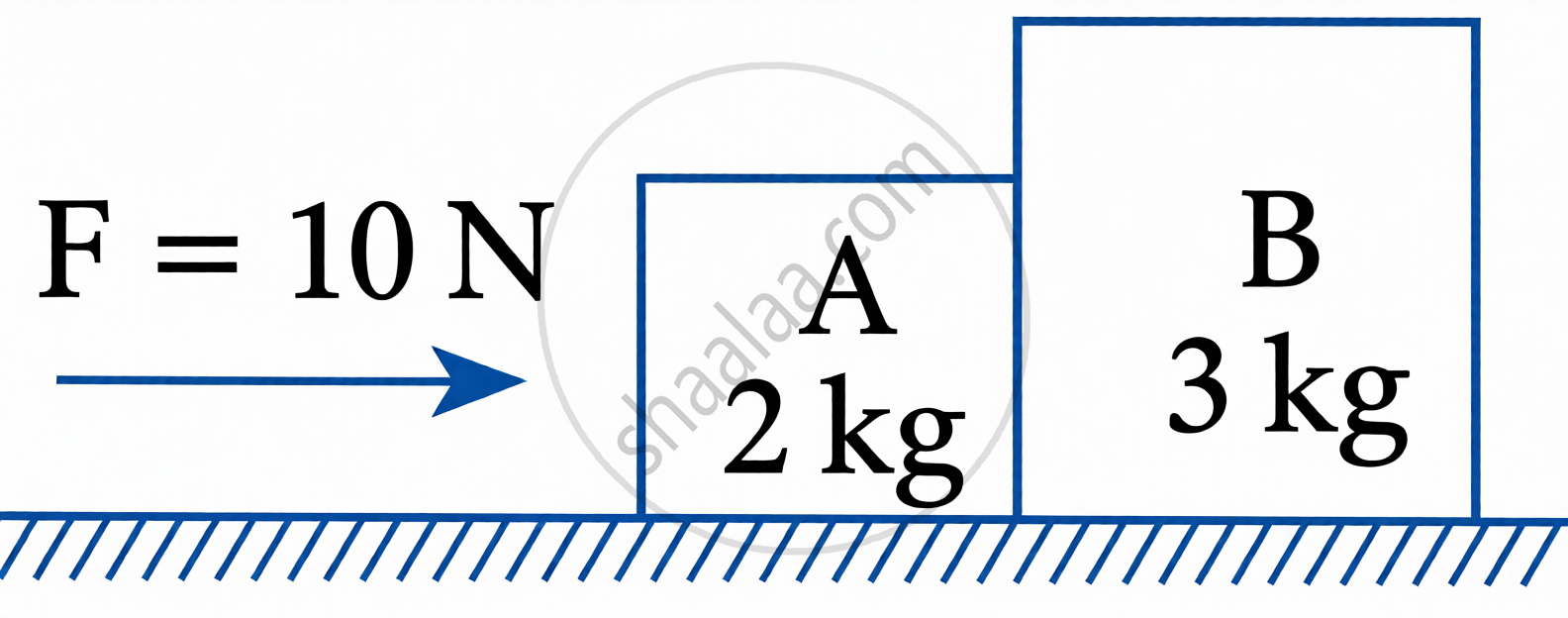
A horizontal force 10 N is applied to a block A as shown in figure. The mass of blocks A and B are 2 kg and 3 kg, respectively. The blocks slide over a frictionless surface. The force exerted by block A on block B is: