Advertisements
Advertisements
Question
An object of mass m begins to move on the plane inclined at an angle θ. The coefficient of static friction of inclined surfaces is µs. The maximum static friction experienced by the mass is ______
Options
mg
µsmg
µsmg sinθ
µs mg cosθ
Advertisements
Solution
An object of mass m begins to move on the plane inclined at an angle θ. The coefficient of static friction of inclined surfaces is µs. The maximum static friction experienced by the mass is µs mg cosθ.
APPEARS IN
RELATED QUESTIONS
Explain various types of friction.
A long stick rests on the surface. A person standing 10 m away from the stick. With what minimum speed an object of mass 0.5 kg should he has thrown so that it hits the stick. (Assume the coefficient of kinetic friction is 0.7).
Briefly explain ‘rolling friction.'
A uniform metal chain is placed on a rough table such that one end of the chain hangs down over the edge of the table. When two-thirds of its chain length hangs over the edge the chain start sliding. Then the coefficient of static friction is:
If a body of mass m is moving on a rough horizontal surface of coefficient of kinetic friction µ, the net resultant force exerted by surface on the body is ______.
A block of mass m is pulled by a constant power P placed on a rough horizontal plane. The friction co-efficient between the block and the surface is µ. Maximum velocity of the block will be:
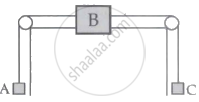
Block A has a mass of 2 kg and block B has 20 kg. If the coefficient of kinetic friction between block B and the horizontal surface is 0.1, and B is accelerating towards the right with a = 2 m/s2, then the mass of the block C will be ______.
(g = 10 m/s2)
A chain of mass 'M' and length 'L' is put on a rough horizontal surface and is pulled by constant horizontal force 'F' as shown in the figure. The velocity of the chain as it turns completely ______.
(Coefficient of friction = μ)

A block of mass 10 kg starts sliding on a surface with an initial velocity of 9.8 ms-1. The coefficient of friction between the surface and bock is 0.5. The distance covered by the block before coming to rest is ______.
[use g = 9.8 ms-2]
There are two inclined surfaces of equal length (L) and same angle of inclination 45° with the horizontal. One of them is rough and the other is perfectly smooth. A given body takes 2 times as much time to slide down, on rough surface than on the smooth surface. The coefficient of kinetic friction (μ) between the object and the rough surface is close to ______.
