Advertisements
Advertisements
प्रश्न
An object of mass m begins to move on the plane inclined at an angle θ. The coefficient of static friction of inclined surfaces is µs. The maximum static friction experienced by the mass is ______
पर्याय
mg
µsmg
µsmg sinθ
µs mg cosθ
Advertisements
उत्तर
An object of mass m begins to move on the plane inclined at an angle θ. The coefficient of static friction of inclined surfaces is µs. The maximum static friction experienced by the mass is µs mg cosθ.
APPEARS IN
संबंधित प्रश्न
State the empirical laws of static and kinetic friction.
Briefly explain ‘rolling friction.'
A block of mass m slides along a floor while a force of magnitude F is applied to it at an angle θ as shown in figure. The coefficient of kinetic friction is µK. Then, the block's acceleration 'a' is given by ______.
(g is acceleration due to gravity)

A uniform chain of length 3 metres and mass 3 kg overhangs a smooth table with 2 metres laying on the table. If k is the kinetic energy of the chain in joule as it completely slips off the table, then the value of k is ______.
(Take g = 10 m/s2)
A 40 kg wooden crate is being pushed across a wooden floor with a force of 160 N. If µk = 0.3, the acceleration of the crate is ______ m/s2. (g = 10 m/s2}
A block of mass m is pulled by a constant power P placed on a rough horizontal plane. The friction co-efficient between the block and the surface is µ. Maximum velocity of the block will be:
A block of mass m = 1 kg moving on horizontal surface with speed u = 2 m/s enters a rough horizontal patch ranging from x = 0.10 m to x = 2.00 m. If the retarding force fr on the block in this range is inversely proportional to x over this range i.e.
fr = `"-k"/x` 0.10 < x < 2.00
= 0 for x < 0.10 and x > 2.00
If k = 0.5 J then the speed of this block as it crosses the patch is (use ℓn 20 = 3)
A chain of mass 'M' and length 'L' is put on a rough horizontal surface and is pulled by constant horizontal force 'F' as shown in the figure. The velocity of the chain as it turns completely ______.
(Coefficient of friction = μ)

There are two inclined surfaces of equal length (L) and same angle of inclination 45° with the horizontal. One of them is rough and the other is perfectly smooth. A given body takes 2 times as much time to slide down, on rough surface than on the smooth surface. The coefficient of kinetic friction (μ) between the object and the rough surface is close to ______.
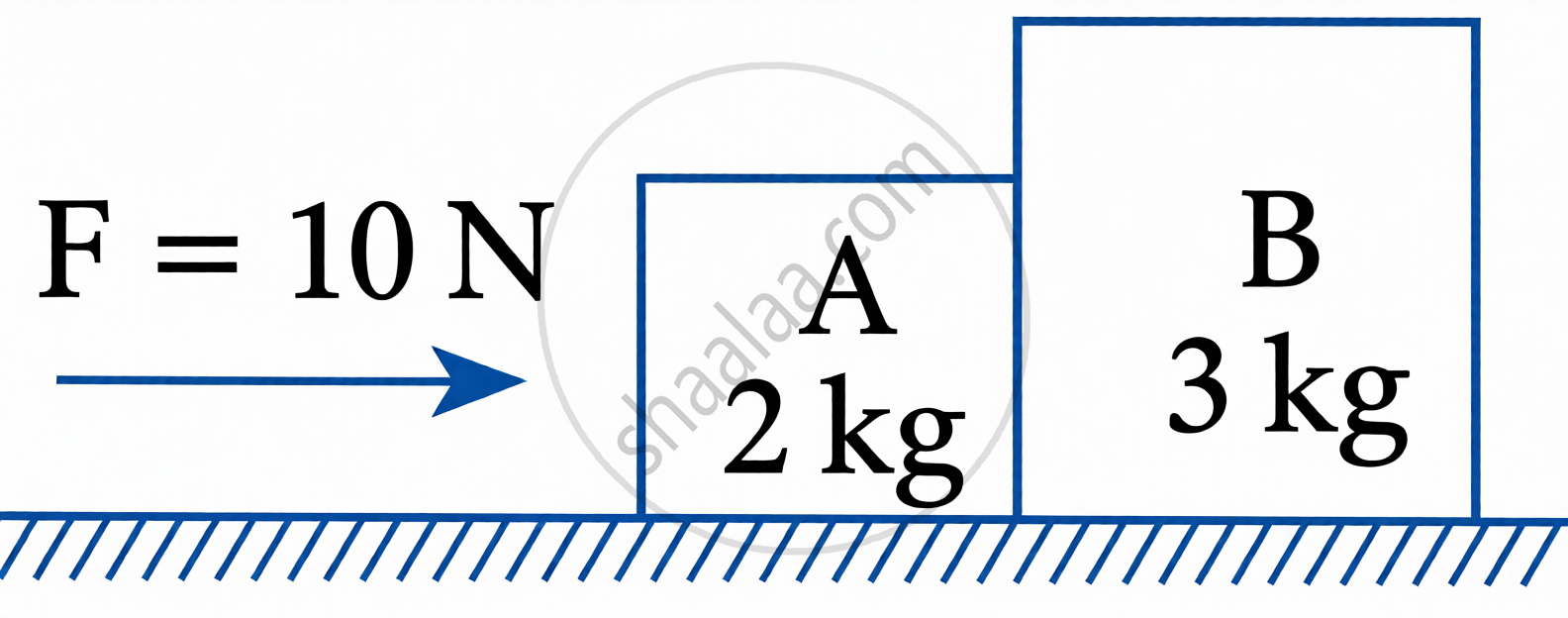
A horizontal force 10 N is applied to a block A as shown in figure. The mass of blocks A and B are 2 kg and 3 kg, respectively. The blocks slide over a frictionless surface. The force exerted by block A on block B is: