Advertisements
Advertisements
प्रश्न
Briefly explain ‘rolling friction.'
Advertisements
उत्तर
The invention of the wheel plays a crucial role in human civilization. One of the important applications is suitcases with rolling on coasters. Rolling wheels makes it easier than carrying luggage. When an object moves on a surface, essentially it is sliding on it. But wheels move on the surface through rolling motion. In rolling motion when a wheel moves on a surface, the point of contact with the surface is always at rest. Since Rolling and kinetic friction, the point of contact is at rest, there is no relative motion between the wheel and surface.

Rolling and kinetic friction
Hence the frictional force is very less. At the same time, if an object moves without a wheel, there is a relative motion between the object and the surface. As a result, the frictional force is larger. This makes it difficult to move the object. The figure shows the difference between rolling and kinetic friction. Ideally in pure rolling, the motion of the point of contact with the surface should be at rest, but in practice, it is not so.
Due to the elastic nature of the surface at the point of contact, there will be some deformation on the object at this point on the wheel or surface as shown in the figure. Due to this deformation, there will be minimal friction between wheel and surface. It is called ‘rolling friction. In fact, rolling friction is much smaller than kinetic friction.
APPEARS IN
संबंधित प्रश्न
An object of mass m begins to move on the plane inclined at an angle θ. The coefficient of static friction of inclined surfaces is µs. The maximum static friction experienced by the mass is ______
A long stick rests on the surface. A person standing 10 m away from the stick. With what minimum speed an object of mass 0.5 kg should he has thrown so that it hits the stick. (Assume the coefficient of kinetic friction is 0.7).
People often say “For every action, there is an equivalent opposite reaction”. Here they meant ‘action of a human’. Is it correct to apply Newton’s third law to human actions? What is mean by ‘action’ in Newton's third law? Give your arguments based on Newton’s laws.
Briefly explain the origin of friction. Show that in an inclined plane, the angle of friction is equal to the angle of repose.
A block of mass 20 kg is sliding on a surface is inclined at an angle of 45° with the horizontal. What will be the acceleration of the block if the coefficient of kinetic friction between the block and the surface is 0.7?
A block of mass m is pulled by a constant power P placed on a rough horizontal plane. The friction co-efficient between the block and the surface is µ. Maximum velocity of the block will be:
A chain of mass 'M' and length 'L' is put on a rough horizontal surface and is pulled by constant horizontal force 'F' as shown in the figure. The velocity of the chain as it turns completely ______.
(Coefficient of friction = μ)

The coefficient of static friction between a car's tires and a level road is 0.80. If the car is to be stopped in a maximum time of 3.0 s, its speed cannot exceed.
There are two inclined surfaces of equal length (L) and same angle of inclination 45° with the horizontal. One of them is rough and the other is perfectly smooth. A given body takes 2 times as much time to slide down, on rough surface than on the smooth surface. The coefficient of kinetic friction (μ) between the object and the rough surface is close to ______.
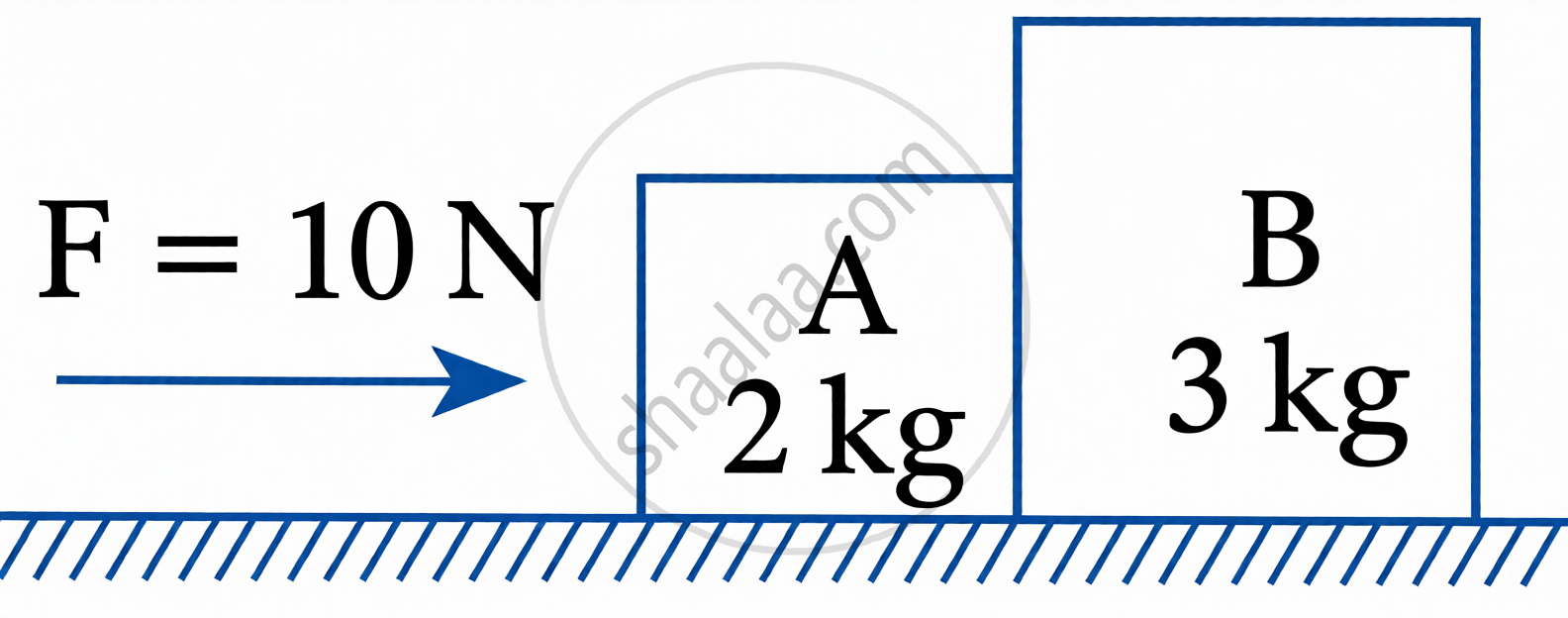
A horizontal force 10 N is applied to a block A as shown in figure. The mass of blocks A and B are 2 kg and 3 kg, respectively. The blocks slide over a frictionless surface. The force exerted by block A on block B is: