Advertisements
Advertisements
Question
Assertion: When water is heated up to 100°C, there is no raise in temperature until all water gets converted into water vapour.
Reason: Boiling point of water is 10°C.
Options
If both assertion and reason are true and reason is the correct explanation of assertion.
If both assertion and reason are true but reason is not the correct explanation of assertion.
If assertion is true but reason is false.
If assertion is false but reason is true.
Advertisements
Solution
If assertion is true but reason is false.
APPEARS IN
RELATED QUESTIONS
State the temperature of ice point on the Celsius scale.
A body absorbs 1680 J of heat energy. How many calories of heat is absorbed by the body?
Explain, why are the taps left dripping in sub-zero temperatures during winter?
Why does a piece of ice when touched with hands appear cold?
Distinguish between heat and temperature.
What is the principle of calorimetry?
Define coefficient of volume expansion.
How can a glass stopper jammed in the neck of a bottle be removed?
Explain the following:
Water is heated generally from below.
Explain the three modes of transfer of heat.
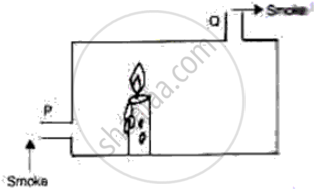
The following figure shows a container in which a lighted candle has been kept. The container has two openings, p, and Q. Which way the smoke from an external source placed near P moves when it reaches P and leaves from Q. Give a reason for your answer.
Where am I?
The isotherm 0°C runs in my surroundings.
Who am I?
I get heated due to the land or water near me
Analogy
Heat : Joule :: Temperature : _____
Figure (a–d) shows the readings on four different thermometers. Indicate which of the reading shows the normal human body temperature?
Temperature is a measure of the average kinetic energy of molecules.
Define absolute zero.
