Advertisements
Advertisements
Question
Answer the following.
What do you understand by a complex machine?
Advertisements
Solution
Machines such as sewing machines or cars that have more than one moving part are called complex machines.
APPEARS IN
RELATED QUESTIONS
Name six simple machines. Give an example of each machine.
What do you understand by a simple machine?
show a nut cracker In the diagram, mark the position of the fulcrum F and the line of action of load L and effort E .
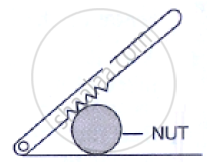
State whether the mechanical advantage of an inclined plane is equal to 1, less than 2 or greater than 1?
Fig. shows a spade. It is being used to lift soil weighing 30N from the ground.
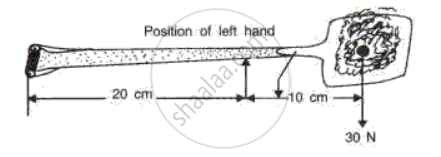
(a) Mark the direction of the least force on the handle necessary to keep the spade balanced.
(b) Calculate the least force on the handle necessary to keep the spade balanced (the weight of the spade is negligible).
(c) If the left hand was move towards the soil on the spade, would the force on the handle necessary to keep the soil balance the greater or less? Give a reason for your answer.
(d) To which class of lever does the spade belong?
What is the efficiency of an ideal machine?
What is the relationship between the mechanical advantage and the velocity ratio for:
- An ideal machine,
- A practical machine.
Give an example of the following use of a machine to obtain gain in force.
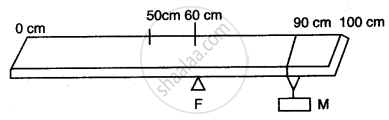
A uniform metre scale is kept in equilibrium when supported at the 60 cm mark and a mass M is suspended from the 90 cm mark as shown in the figure. State with reasons, whether the weight of the scale is greater than, less than or equal to the weight of mass M.
Classify the following as a lever, a pulley and an inclined plane:
A staircase
