Advertisements
Advertisements
Question
Explain with examples types of asexual reproduction in unicellular organisms.
Advertisements
Solution
Asexual reproduction occurs in unicellular organisms through various methods. Some of these methods are as follows:
- Binary Fission: In this method, the parent cell divides into two equal parts, resulting in the formation of two new daughter cells. This division occurs through mitotic division. Generally, binary fission occurs in favourable conditions when sufficient food is available. Bacteria, protozoa, mitochondria, and chloroplasts reproduce asexually through binary fission.
Depending on the axis of division, binary fission in different protozoa is classified as:- Simple Binary Fission: Since Amoeba does not have a definite shape, it can divide along any axis. Therefore, this type of fission is called simple binary fission.
Example: Amoeba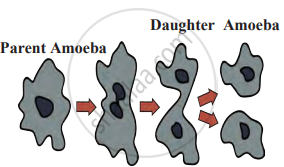
- Transverse (Horizontal) Binary Fission: In Paramecium, division occurs along the transverse axis.
Example: Paramecium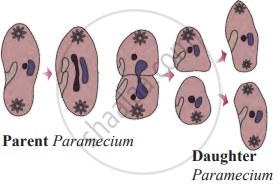
- Longitudinal (Vertical) Binary Fission: In Euglena, division occurs along the longitudinal axis.
Example: Euglena
- Simple Binary Fission: Since Amoeba does not have a definite shape, it can divide along any axis. Therefore, this type of fission is called simple binary fission.
- Multiple Fission: Amoeba and similar unicellular protozoa reproduce asexually through multiple fission in unfavourable conditions. When food is insufficient or environmental conditions become unfavourable, Amoeba stops moving and does not produce pseudopodia. It becomes spherical and forms a hard protective covering around itself, known as a “Cyst”.
Inside the cyst, the nucleus undergoes multiple mitotic divisions, resulting in the formation of several nuclei. Later, the cytoplasm also divides, producing multiple small Amoebae. These remain inside the cyst until favourable conditions return. Once conditions improve, the cyst bursts, releasing several young Amoebae.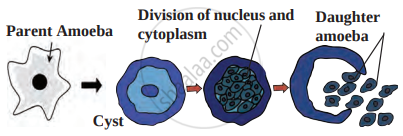
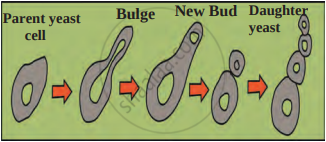
- Budding: Yeast reproduces asexually through budding. First, mitotic division occurs in the parent cell, producing two daughter nuclei. A small outgrowth, called a "Bud", appears on the parent cell. One of the daughter nuclei enters this bud. After growing sufficiently, the bud detaches from the parent cell and starts developing as an independent yeast cell.
RELATED QUESTIONS
Choose the odd one in each of the following:
Seminiferous tubule; ovum; epididymis; sperm duct; urethra
The diagram given below represents a system in the human body. Stud the diagram and answer the following questions: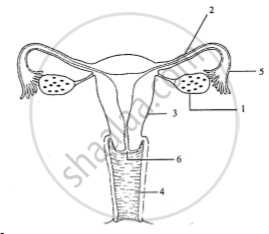
Name the two hormones secreted by 1.
Name the following:
The parts of the ovary containing mature ovum.
Name the Following
Surgical operation of the fallopian tubes in females for family planning.
Identify the distal narrow part of the duct opening into the uterus.
Contraction of which muscles are responsible for causing labour during parturition?
Penis is homologous to ____________.
The development of lactiferous tubules during pregnancy is dependent on ____________.
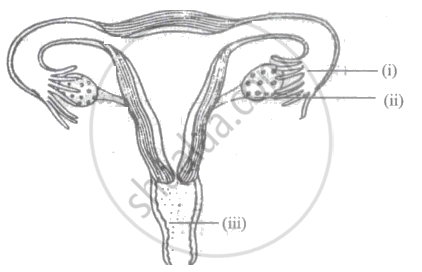
Identify the labels (i, ii and iii) in the given diagram of the female reproductive system.
Ovulation occurs under the influence of ______.
When both ovaries are removed from rat which hormone is decreased in blood?
After birth, colostrum is released from mammary glands which is rich in ______.
Which of the following is correct about mammalian testes?
The opening of the vagina is often covered partially by a membrane called ______.
Which among the following diseases is not sexually transmitted?
How can we say that fish exhibits external fertilisation?
With a suitable diagram, describe the organisation of mammary gland.
The______ is also called the womb.
List two roles of the Oviduct in the human reproductive system.
Given below is a group of terms. In the group, one pair indicates the relationship between the two terms. Rewrite and complete the second pair on a similar basis.
Leydig cells : Testosterone : ______ : Oestrogen.
