Advertisements
Advertisements
Question
Answer the following question.
Golu’s relatives did not answer his questions because
Options
they were shy
the questions were too difficult
Golu was a naughty baby
Advertisements
Solution
Golu’s relatives did not answer his questions because the questions were too difficult.
RELATED QUESTIONS
Do you like rain? What do you do when it rains steadily or heavily as described in the poem?
Study the words in italics in the sentences below. They are formed by prefixing un – or in – to their antonyms (words opposite in meaning).
• I was a short boy with rather undistinguished looks. (un + distinguished)
• My austere father used to avoid all inessential comforts.(in + essential)
• The area was completely unaffected by the war.(un + affected)
• He should not spread the poison of social inequality and communal intolerance. (in + equality, in+ tolerance)
Now form the opposites of the words below by prefixing un- or in-. The prefix in- can also have the forms il-, ir-, or im- (for example: illiterate –il + literate, impractical –im + practical, irrational – ir+ rational). You may consult a dictionary if you wish.
| _____adequate | _____acceptable | _____regular | _____tolerant |
| ____demanding | ____active | _____true | _____permanent |
| ____patriotic | ____disputed | ____accessible | _____coherent |
| _____logical | _____legal | _____responsible | _____possible |
Imagine that you are the poet, William Wordsworth. You continue on your walk, and when you reach home you tell a friend what you saw and felt. Which of the following best describes your experience? (Work in pairs, then have a class discussion.)
|
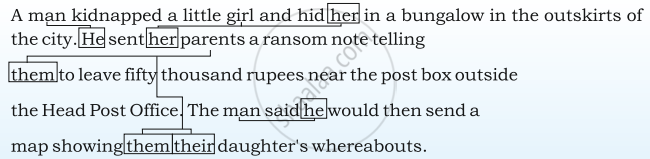
Look at the passage below and study how the personal pronouns refer to different people.
Old Kaspar took it from the boy,
Who stood expectant by;
And then the old man shook his head,
And,with a natural sigh,
"Tis some poor fellow's skull," said he,
"Who fell in the great victory.
"I find them in the garden,
For there's many here about;
And often when I go to plough,
The ploughshare turns them out!
For many thousand men,"said he,
"Were slain in that great victory."
Read the lines given above and answer the question that follow.
What words show that there were many such skulls to be found there?
“Jane,” said the wheelwright, with an impressiveness of tone that greatly subdued his wife, “I read in the Bible sometimes, and find much said about little children. How the Savior rebuked the disciples who would not receive them; how he took them up in his arms, and blessed them; and how he said that ‘whosoever gave them even a cup of cold water should not go unrewarded.’ Now, it is a small thing for us to keep this poor motherless little one for a single night; to be kind to her for a single night; to make her life comfortable for a single night.”
The voice of the strong, rough man shook, and he turned his head away, so that the moisture in his eyes might not be seen. Mrs. Thompson did not answer, but a soft feeling crept into her heart.
“Look at her kindly, Jane; speak to her kindly,” said Joe. “Think of her dead mother, and the loneliness, the pain, the sorrow that must be on all her coming life.” The softness of his heart gave unwonted eloquence to his lips.
Read the extract given below and answer the question that follow.
What did Joe want to convey to his wife from his quotes from the Bible?
Most terribly cold it was; it snowed, and was nearly quite dark, and evening— the last evening of the year. In this cold and darkness there went along the street a poor little girl, bareheaded, and with naked feet. When she left home she had slippers on, it is true; but what was the good of that? They were very large slippers, which her mother had hitherto worn; so large were they; and the poor little thing lost them as she scuffled away across the street, because of two carriages that rolled by dreadfully fast.
One slipper was nowhere to be found; the other had been laid hold of by an urchin, and off he ran with it; he thought it would do capitally for a cradle when he some day or other should have children himself. So the little maiden walked on with her tiny naked feet, that were quite red and blue from cold. She carried a quantity of matches in an old apron, and she held a bundle of them in her hand. Nobody had bought anything of her the whole livelong day; no one had given her a single farthing. She crept along trembling with cold and hunger—a very picture of sorrow, the poor little thing!
Read the extract given below and answer the question that follow.
Had she managed to sell any matches?
The king had done right things at the right time. Explain giving three examples.
What is the moral of the story, elaborate it.
What proves that Mr Gessler was not an Englishman?
How did Mr Gessler described his brother?
How did the other bird greet the king?
What do you think the man said to his friend who waited at the door?
Look at these sentences.
1. “Too boring,” he said.
2. Cleaned his room, did his chores.
When we speak, we often leave out words that can easily be guessed. We do not do this when we write unless we are trying to write as we speak (as in the story).
So, if we were to write carefully, we would say:
- “Homework is too boring,” he said.
- He cleaned his room and did his chores.
Answer the following question:
How did Taro’s father show his happiness after drinking saké?
Talk to your partner and say whether the following statement is true or false.
No animal can survive without water.
Replace the italicised portion of the sentence below with a suitable phrase from the box. Make necessary changes, wherever required.
They criticised him in the meeting but he accepted without protest all the criticism.
What decisions were given by Algu and Jumman as head Panch?
How did Rasheed lose all his money at the Lucky shop?
Why does the speaker’s brother lie to him?
