Advertisements
Advertisements
Question
Answer the following question briefly:
Music and dance during the Sultanate period were the outcomes of the fusion of Indo-Islamic culture. Explain.
Advertisements
Solution
Indian or Hindustani music was the outcome of the fusion of the Perso-Arabic and Indian classical music styles. New musical instruments such as the tabla, sitar, and sarangi were developed during this time. “The famous Persian poet, Amir Khusrau, is believed to have invented the sitar by combining the South Indian veena with the Persian tanpura. The South Indian drum was probably altered to create the table. ‘The Persian style of chorus singing, known as qawwali, was popularized by the Sufi saints, a group of Muslim mystics who became popular during this period. They sang devotional songs at their religious meetings. Kathak, a new dance form that also developed during this time, combines Hindu themes with Persian customs.
RELATED QUESTIONS
What evidence do we have to prove that Alauddin was a patron of art and learning?
This is a picture of the most beautiful specimen of Khilji architecture, which was added as an entrance to the Qutb complex in Delhi.
Identify the monument.
Answer the following question briefly:
Describe the important developments which took place in the following fields during the Sultanate period:
Music
Fill in the blank:
New musical instruments such as the ___________ were developed during the Sultanate period.
State whether the following is true or false:
The Rajput style of miniature painting continued in the Sultanate period.
Answer the following question in one or two words/sentences:
During whose reign did the life and conditions of the peasants improve?
Answer the following question in one or two words/sentences:
Which two styles of music influenced the development of Hindustani music?
Answer the following question briefly:
Explain how new customs and practices changed the traditional lifestyle of the Indians.
This is a picture of a musical instrument used in Hindustani classical music. The name is derived from the Persian words—‘seh’ (meaning ‘three’) and tar’ (meaning ‘strings’).
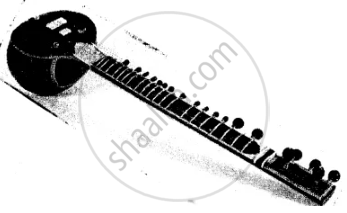
Identify the musical instrument.
This is a picture of a musical instrument used in Hindustani classical music. The name is derived from the Persian words ‘seh’ (meaning ‘three’) and tar’ (meaning ‘strings’).
By whom and how was it invented?
