Advertisements
Advertisements
Question
An atom consists of charged particles called electrons and protons. Each proton has a charge of +1 and each electron has a charge of –1. Remember number of electrons is equal to number of protons, while answering these questions:
- What is the charge on an atom?
- What will be the charge on an atom if it loses an electron?
- What will be the charge on an atom if it gains an electron?
Advertisements
Solution
a. Let a be the number of electrons in an atom.
Number of protons in the atom, will also be equal to a.
Since, an atom has equal number of protons and electrons.
∴ Charge on one electron = (–1)
∴ Total charge in a electrons = a × (–1) = –a
∴ Charge on one proton = (+1)
∴ Total charge in a protons = a × (+1) = + a
Hence, total charge on the atom = Charge of electrons + Charge of protons
= –a + a
= 0
b. If an atom loses an electron, it will have (a – 1) electrons and a protons.
∴ Charge in one electron = (–1)
∵ Charge in (a – 1) electrons = (a – 1) × (–1) = – (a – 1) = (1 – a)
∴ Charge in one proton = (+1)
∵ Charge in a protons = (+1) × a = (+a)
Hence, total charge on the atom = Charge of electrons + Charge of protons
= 1 – a + a
= + 1
c. If an atom gains an electron, it will have (a + 1) electrons and a protons
∴ Charge in one electron = –1
∴ Charge in (a + 1) electrons = –1 × (a + 1) = –(a + 1)
∴ Charge in one proton = (+1)
∴ Charge in a protons = (+1) × a = (+ a)
Hence, total charge on the atom = Charge of electrons + Charge of protons
= a – (a + 1)
= (–1)
APPEARS IN
RELATED QUESTIONS
Write the opposite of the following: A loss of Rs 7
Write the opposite of the following: -34
Write the successor of the following: −99
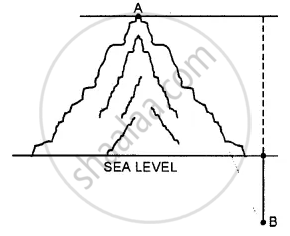
The point A is on a mountain which is 5700 metres above sea level and the point B is in a mine which is 39600 metres below sea level. Find the vertical distance between A and B.
Multiply: (–746) by (–8)
Multiply: 118 by −7
2 less than −7 is
Fill in the blanks.
The predecessor of −200 is ...... .
Write six distinct integers whose sum is 7.
Represent the following numbers as integers with appropriate signs.
A submarine is moving at a depth, of eight hundred metres below sea level.
