Advertisements
Advertisements
Question
ΔAMT∼ΔAHE, construct Δ AMT such that MA = 6.3 cm, ∠MAT=120°, AT = 4.9 cm and `"MA"/"HA"=7/5`, then construct ΔAHE.
Advertisements
Solution
Δ AMT and Δ AHE are give
⇒ `("MA")/("HA")= ("AT")/("AE") =("TM")/("EH")=7/5`
⇒ `("MA")/("HA")=7/5 ⇒ 6.3/"HA" =7/5`
⇒ `"HA" =(6.3xx5)/7`
⇒ HA = 4.5cm
Similarly, `"AT"/"AE" =7/5`
⇒ `4.9/"AE" =7/5 ⇒"AE" =(4.9xx5)/7⇒"AE"=3.5`cm
Given triangle Required triangle
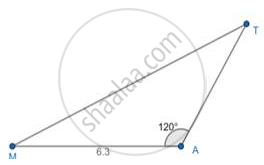
Steps of Constructing the required triangle:
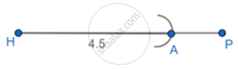
1. Draw a line segment of some length HP and mark an arc of 4.5cm(as calculated above) and name it as A.
2. At vertex A, make an angle of 120°
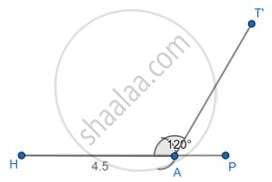
3. Mark an arc of 3.5cm (as calculated above) on AT’ and name it E.
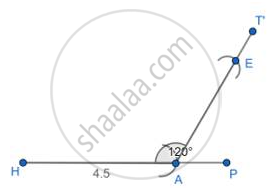
4. Join HE.
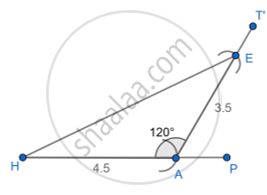
5. Δ AHE is the required triangle.
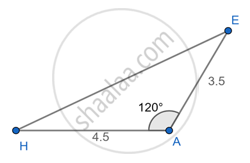
APPEARS IN
RELATED QUESTIONS
If \[\tan \theta = \frac{3}{4}\], find the values of secθ and cosθ
If \[\cot\theta = \frac{40}{9}\], find the values of cosecθ and sinθ.
Prove that:
Prove that:
(secθ - cosθ)(cotθ + tanθ) = tanθ.secθ.
Prove that:
Prove that: `1/"sec θ − tan θ" = "sec θ + tan θ"`
Prove that:
Prove that:
If \[\tan\theta + \frac{1}{\tan\theta} = 2\], then show that \[\tan^2 \theta + \frac{1}{\tan^2 \theta} = 2\]
Choose the correct alternative answer for the following question.
cosec 45° =?
Choose the correct alternative answer for the following question.
1 + tan2 \[\theta\] = ?
Prove the following.
(secθ + tanθ) (1 – sinθ) = cosθ
Prove the following.
sec2θ + cosec2θ = sec2θ × cosec2θ
Prove the following.
cot2θ – tan2θ = cosec2θ – sec2θ
Prove the following.
Prove the following.
Prove that: (sec θ – cos θ) (cot θ + tan θ) = tan θ.sec θ
Proof: L.H.S. = (sec θ – cos θ) (cot θ + tan θ)
= `(1/square - cos θ) (square/square + square/square)` ......`[∵ sec θ = 1/square, cot θ = square/square and tan θ = square/square]`
= `((1 - square)/square) ((square + square)/(square square))`
= `square/square xx 1/(square square)` ......`[(∵ square + square = 1),(∴ square = 1 - square)]`
= `square/(square square)`
= tan θ.sec θ
= R.H.S.
∴ L.H.S. = R.H.S.
∴ (sec θ – cos θ) (cot θ + tan θ) = tan θ.sec θ
