Advertisements
Advertisements
प्रश्न
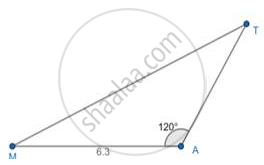
ΔAMT∼ΔAHE, construct Δ AMT such that MA = 6.3 cm, ∠MAT=120°, AT = 4.9 cm and `"MA"/"HA"=7/5`, then construct ΔAHE.
Advertisements
उत्तर
Δ AMT and Δ AHE are give
⇒ `("MA")/("HA")= ("AT")/("AE") =("TM")/("EH")=7/5`
⇒ `("MA")/("HA")=7/5 ⇒ 6.3/"HA" =7/5`
⇒ `"HA" =(6.3xx5)/7`
⇒ HA = 4.5cm
Similarly, `"AT"/"AE" =7/5`
⇒ `4.9/"AE" =7/5 ⇒"AE" =(4.9xx5)/7⇒"AE"=3.5`cm
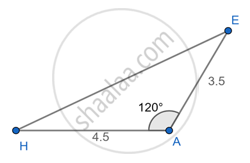
Given triangle Required triangle
Steps of Constructing the required triangle:
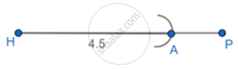
1. Draw a line segment of some length HP and mark an arc of 4.5cm(as calculated above) and name it as A.
2. At vertex A, make an angle of 120°
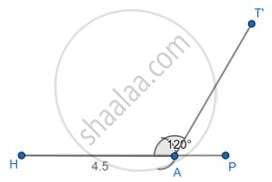
3. Mark an arc of 3.5cm (as calculated above) on AT’ and name it E.
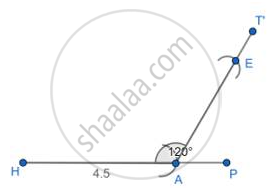
4. Join HE.
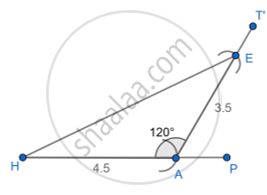
5. Δ AHE is the required triangle.
APPEARS IN
संबंधित प्रश्न
If \[\tan \theta = \frac{3}{4}\], find the values of secθ and cosθ
If 5 secθ – 12 cosecθ = 0, find the values of secθ, cosθ, and sinθ.
Prove that:
cos2θ (1 + tan2θ)
Prove that:
Prove that:
Prove that:
Prove that:
Choose the correct alternative answer for the following question.
1 + tan2 \[\theta\] = ?
Choose the correct alternative answer for the following question.
Prove the following.
secθ (1 – sinθ) (secθ + tanθ) = 1
Prove the following.
sec2θ + cosec2θ = sec2θ × cosec2θ
Prove the following.
Prove the following:
sec6x – tan6x = 1 + 3sec2x × tan2x
Prove the following.
\[\frac{\tan\theta}{\sec\theta + 1} = \frac{\sec\theta - 1}{\tan\theta}\]
Prove the following.
Show that:
`sqrt((1-cos"A")/(1+cos"A"))=cos"ecA - cotA"`
In ΔPQR, ∠P = 30°, ∠Q = 60°, ∠R = 90° and PQ = 12 cm, then find PR and QR.
