Advertisements
Advertisements
Question
All life owes its existence to chlorophyll. Give reason.
Advertisements
Solution
Chlorophyll is the foundation site for the photosynthesis in green plants. The initiation of photosynthesis takes place when the chlorophyll molecule traps the light energy. The light energy is then converted into chemical energy in the form of glucose using carbon dioxide (CO2) from the atmosphere, and water (H2O) from the soil. All other organisms, directly or indirectly depend on this food for their survival. The starting point of any food chain is always a plant. If green plants were to suddenly disappear, then so would virtually all life on Earth. Thus, we can say that all life owes its existence to chlorophyll.
RELATED QUESTIONS
An experiment was set up as shown in the figure given below . The twig in the diagram was intact on the plant and it was as such in sunlight for a few hours .
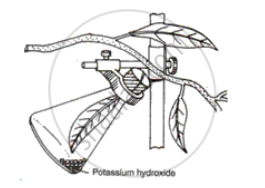
(i) What is the aim of the above experiment ?
(ii) Why was potassium hydroxide placed inside the conical flask ?
(iii) What test would you perform on the leaf inside the flask?
(iv) What is the expected result of the above test ?
(v) Is it necessary to similarly test on outer leaf also ? Giva a reason .
Name the following:
The main mineral constituent of chlorophyll.
Mention one difference between the following on the basis of what is given in bracket.
Chlorophyll and chloroplast (part of plant cell)
How would you demonstrate that green plants release oxygen when exposed to light?
Given below is the representation of a certain phenomenon in nature. With four organisms 1-4.
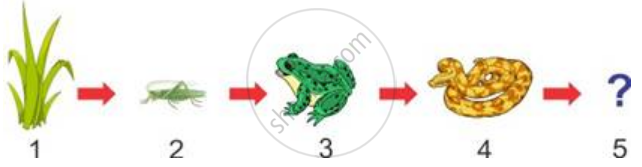
Name any one organism that could be shown at No .5
Given below is the representation of a certain phenomenon in nature. With four organisms 1-4.

Name the biological process which was the starting point of the whole chain.
The diagram below shows two test-tubes A and B. Test-tube A contains a green water plant. Test-tube B contains both a green water plant and a snail. Both test-tubes are kept in sunlight. Answer the questions that follow:

(a) Name the physiological process that releases the bubbles of oxygen.
(b) Explain the physiological process as mentioned above in (a).
(c) What is the purpose of keeping a snail in test-tube B?
(d) Why does test-tube B have more bubbles of oxygen?
(e) Give an example of a water plant that can be used in the above experiment.
(f) Write the overall chemical equation for the above process.
Complete the following sentence with appropriate word:
A light-induced reaction which leads to the splitting of water is _____ of water.
Choose the Odd One Out
Given below is the diagram of an experimental set-up (final stage). Study the same and answer the following questions:

- What is the main aim of the experiment?
- Oxygen gas shown in the experiment is released from which of the raw materials?
- How would you confirm the presence of oxygen gas?
- Name the chemical substance which can be added in water to enhance the process/rate of release of oxygen gas.
- Draw a neat and labelled diagram of the same experiment for its initial stage.
