Advertisements
Advertisements
Question
After puberty human female shows cyclic changes in her reproductive system. Explain structural and hormonal changes in the uterus.
(OR)
Give reasons :
(1) Scrotal sac serves as thermoregulator.
(2) Corpus luteum gets converted into corpus albicans in absence of fertilization.
(3) Missing of menses is the first indication of pregnancy.
(4) Surgical sterilization is a permanent method of birth control. (5) Human egg is microlecithal.
Advertisements
Solution
1) Menstrual phase : When the ovum is not fertilized the high level progesterone inhibits secretion of luteinising hormone and LH level decreases. This results in decrease in the level of progesterone from corpus luteum. When the amount of progesterone further decreases and stimulates – anterior pituitary to secrete FSH and proliferative phase begins the basal part of endometrium remains intact and thickness is only about 1 mm.

2) Proliferative phase : During this phase he primordial follicle of the ovary develops into Graafian follicle. Many primordial follicles are already present in the ovary. The ovum bceomes eccentric and it is connected by few follicular cells called germ hill or cumulus oophorus or discus proligerous. The granulosa cells lining the antrum form membrana granulosa and follicular cells surrounding the ovum are called corona radiata. The ovum increases in size. Thick membrane is formed surrounding the outer surface of ovum. This is called zona pellucida. From stroma of ovary, follicle is covered with two layers called theca interna and theca externa. Theca interna is vascular layer with loose connective tissue. These cells become endocrine and secrete female sex hormone called oestrogens.
Changes in Uterus : Oestrogen secreted by follicular cells of ovary stimulate endometrial glands. This causes repair of endometrium. The endometrial cells proliferate and thickness of endometrium grows to about 3 mm to 5 mm.
3) Ovulatory Phase : Ovulation is the process in which there is rupture of Graafian follicle with discharge of ovum into obdominal cavity. It is under the influence of luteinising hormone. A sudden rise in level of LH stimulates ovulation which occurs usually on 14th day of menstrual cycle.
4) Secretory phase : Corpus luteum formed in ovary secretes progesterone. It cauases further growth of endometrial glands. Uterine glands secrete fluid which is rich in glycogen for nourishing the dividing embryo. I is also called uterine milk. Thus, further increase in thickness of endometrium takes place (5 mm to 6 mm). If fertilization occurs, embryo is implanted in thickened endometrium.
(OR)
Scrotal sac serves as thermoregulator as it
(1) Regulates temperature for spermatogenesis in testis.
(2) As there is no fertilization at the end of secretory phase corpus luteum stops secreting progesterone and LH secretion also stops from anterior pituitary so corpus luteum gets degenerates to corpus albicans.
(3) Due to fertilization, corpus luteum increases in size and secretes progesterone and maintains thickness of endometrium due to this there is no menstruation. So, missing of menses is the first indication of pregnancy.
(4) Surgical sterilizatoin is a permanent method of birth control as surgical intervention blocks gamete transport and prevent pregnancy.
(5) Human egg is microlecithal as it is almost free of yolk.
APPEARS IN
RELATED QUESTIONS
Name the function of the following:
Endometrium
Why is zona pellucid retained around the egg till it reaches the uterus?
Observe the diagram and answer the following questions.
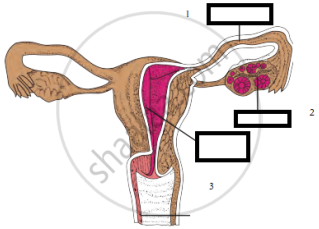
- Label the indicated parts 1, 2 and 3 in the diagram.
- Where the fertilization of ovum occurs?
- Where does the embryo get implanted after fertilization?
Cleavage in mammalian egg is ______.
To answer the question, study the graphs below for Subjects 1 and 2 showing different levels of certain hormones.
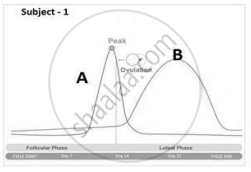
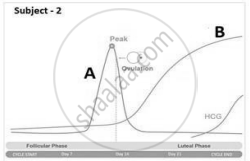
If the peak of Hormone A does not appear in the study for Subject 1, which of the following statement is true?
Match the following:
| Ovaries | Bean shape |
| Fallopian tubes | Almond shape |
| Uterus | Funnel – shape |
| Kidney | pear-shaped |
With a suitable diagram, describe the organisation of mammary gland.
The______ is also called the womb.
Rewrite the terms in the correct order so as to be in a logical sequence.
Graafian follicle, ostium, uterus, fallopian tube, ovum.
What do mammary glands produce to nourish the offspring after birth?
