Advertisements
Advertisements
Question
ABCDE is a regular pentagon. The bisector of angle A of the pentagon meets the side CD in point M. Show that ∠AMC = 90°.
Advertisements
Solution
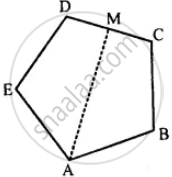
Given: ABCDE is a regular pentagon.
The bisector ∠A of the pentagon meets the side CD at point M.
To prove : ∠AMC = 90°
Proof: We know that the measure of each interior angle of a regular pentagon is 108°.
∠BAM = 
Since, we know that the sum of a quadrilateral is 360°
In quadrilateral ABCM, we have
∠BAM + ∠ABC + ∠BCM + ∠AMC = 360°
54° + 108° + 108° + ∠AMC = 360°
∠AMC = 360° – 270°
∠AMC = 90°
APPEARS IN
RELATED QUESTIONS
In Fig. 16.19, ABCD is a quadrilateral.
How many pairs of adjacent angles are there?

Two angles of a quadrilateral are of measure 65° and the other two angles are equal. What is the measure of each of these two angles?
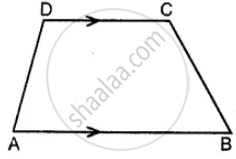
The following figure shows a quadrilateral in which sides AB and DC are parallel. If ∠A : ∠D = 4 : 5, ∠B = (3x – 15)° and ∠C = (4x + 20)°, find each angle of the quadrilateral ABCD.
One angle of a hexagon is 140° and the remaining angles are in the ratio 4 : 3 : 4 : 5 : 4. Calculate the measures of the smallest and the largest angles.
The number of straight angles in the following figure is ______.

Using the information given, name the right angles in part of figure:
AC ⊥ CD

An angle is said to be trisected, if it is divided into three equal parts. If in the following figure, ∠BAC = ∠CAD = ∠DAE, how many trisectors are there for ∠BAE?

Can we have two obtuse angles whose sum is a complete angle? Why or why not?
In quadrilateral PQRS, which pair represents adjacent sides?
Which of the following is a key requirement for correctly naming a □ABCD?
