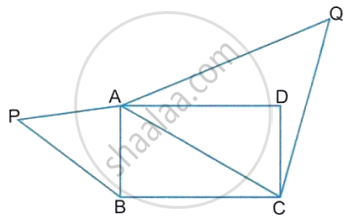
ABCD is a rectangle in which side BC is twice side AB. If \(\triangle \mathrm{ACQ} \sim \triangle \mathrm{BAP}\), find area of \(\Delta \mathrm{BAP}\) : area of \(\Delta \mathrm{ACQ}\).
Advertisements
Question
ABCD is a rectangle in which side BC is twice side AB. If \(\triangle \mathrm{ACQ} \sim \triangle \mathrm{BAP}\), find area of \(\Delta \mathrm{BAP}\) : area of \(\Delta \mathrm{ACQ}\).
Sum
Advertisements
Solution
Since ΔACQ ∼ ΔBAP, corresponding sides are proportional; in particular AC ↔ BA.
For similar triangles, \[\frac{\operatorname{ar}(\triangle ACQ)}{\operatorname{ar}(\triangle BAP)} =\left(\frac{AC}{BA}\right)^2.\]
In rectangle ABCD, BC = 2AB, so \[AC^2 = AB^2 + BC^2\]
\[= AB^2 + (2AB)^2\]
\[= 5AB^2\]
\[\frac{AC}{BA} = \sqrt{5}\]
Therefore \[\frac{\operatorname{ar}(\triangle ACQ)}{\operatorname{ar}(\triangle BAP)} = 5.\]
Hence \[\operatorname{ar}(\triangle BAP):\operatorname{ar}(\triangle ACQ) = 1 : 5.\]
shaalaa.com
Is there an error in this question or solution?
