Advertisements
Advertisements
Question
ABCD is a quadrilateral in which measures of angle D and angle C are 60 degrees, and 100 degrees respectively. If the internal bisectors of angle A and angle B meet at P, then measure of angle APB is
Options
80°
90°
100°
110°
Advertisements
Solution
80°
Explanation:
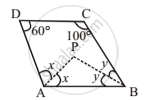
Let ∠BAD = 2x and ∠ABC = 2y.
then, in quadrilateral ABCD,
∠(A + B +C +D) = 360°
2x+ 2y +100° + 60° = 360°
2 (x + y) = 200°
∴ (x + y) = 100° .............(i)
As, AP and BP are angle bisector of ∠A and ∠B respectively
Then, ∠BAP = x and ∠ABP = y.
Again in ΔAPB, the sum of angles 180°
APPEARS IN
RELATED QUESTIONS
Solve the following question and mark the best possible option.
Using the digits 1,2 find the number of natural numbers, which are smaller than 2 × 10⁸.
If `|(1,2,4),(3,6+x,7),(5,10,4+x)| = 0`, then the value of x will be:
`lim_(x->0) "tan 2 x - x"/"3x - sin x"` is equal to:
In algebra, we use alphabets such as a, b, c to denote
A wheel that has 6 cogs is meshed with a larger wheel of 14 cogs. When the smaller wheel has made 21 revolutions, then the number of revolutions made by the larger wheel is
The square root of 289 is
If `x + 1/x = 3, "then" x^2 + 1/x^2` = ______.
The sum of the three numbers in AP is 21 and the product of the first and third numbers of the sequence is 45. What are the three numbers?
If the fractions `5/14, 6/11, 7/9, 8/13` and `9/10` are arranged in ascending order of their values, which one will be the fourth?
Find the least number by which 77, 175 should be divided to make it a perfect cube number.
