Advertisements
Advertisements
प्रश्न
ABCD is a quadrilateral in which measures of angle D and angle C are 60 degrees, and 100 degrees respectively. If the internal bisectors of angle A and angle B meet at P, then measure of angle APB is
विकल्प
80°
90°
100°
110°
Advertisements
उत्तर
80°
Explanation:
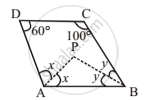
Let ∠BAD = 2x and ∠ABC = 2y.
then, in quadrilateral ABCD,
∠(A + B +C +D) = 360°
2x+ 2y +100° + 60° = 360°
2 (x + y) = 200°
∴ (x + y) = 100° .............(i)
As, AP and BP are angle bisector of ∠A and ∠B respectively
Then, ∠BAP = x and ∠ABP = y.
Again in ΔAPB, the sum of angles 180°
APPEARS IN
संबंधित प्रश्न
Solve the following question and mark the best possible option.
Using the digits 1,2 find the number of natural numbers, which are smaller than 2 × 10⁸.
If ωω the cube root of unity then the value of `|(1, ωω, ωω^2),(ωω,ωω^2,1),(ωω^2,1,ω)|` will be:
`lim_(x->0) "tan 2 x - x"/"3x - sin x"` is equal to:
The vertex of the parabola x2 – y + 6x + – = 0 is:
Number of methods to find square root of an algebric expression are
2/3 is a rational number whereas √2/√ 3 is:
Ten years ago, Sunil was half of Sudip's age. If the age of both at present is in the ratio of 3:4, what will be the total of their present age?
You can collect rubies and emeralds as many as you can. Each ruby is worth ₹4 crore and each emerald is worth ₹5 crore. Each ruby weights 0.3 kg and each emerald weights 0.4 kg. Your bag can carry at the most 12 kg. What you should collect to get the maximum wealth?
In GP find 1 + `1/2`+ `1/4` + ... up to 5 terms.
If the fractions `5/14, 6/11, 7/9, 8/13` and `9/10` are arranged in ascending order of their values, which one will be the fourth?
