Advertisements
Advertisements
Question
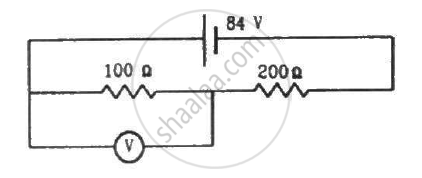
A voltmeter of resistance 400 Ω is used to measure the potential difference across the 100 Ω resistor in the circuit shown in the figure. (a) What will be the reading of the voltmeter? (b) What was the potential difference across 100 Ω before the voltmeter was connected?
Advertisements
Solution
(a) The effective resistance of the circuit,
\[R_{eff} = \frac{100 \times 400}{500} + 200 = 280 \Omega\]
The current through the circuit,
\[i = \frac{84}{280} = 0 . 3 A\]
Since 100 Ω resistor and 400 Ω resistor are connected in parallel, the potential difference will be same across their ends. Let the current through 100 Ω resistor be i1 ; then, the current through 400 Ω resistor will be i - i1.
\[100 i_1 = 400\left( i - i_1 \right)\]
\[ \Rightarrow 500 i_1 = 400i\]
\[ \Rightarrow i_i = \frac{4}{5}i = 0 . 24 A\]
The reading of the voltmeter = 100 × 0.24 = 24 V
(b) Before the voltmeter is connected, the two resistors 100 Ω resistor and 200 Ω resistor are in series.
The effective resistance of the circuit,
\[R_{eff} = \left( 200 + 100 \right)\]
\[ = 300 \Omega\]
The current through the circuit,
\[i = \frac{84}{300} = 0 . 28 A\]
∴ Voltage across the 100 Ω resistor = (0.28 × 100) = 28 V
