Advertisements
Advertisements
Question
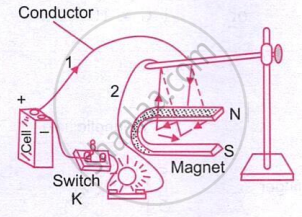
- Suspend a conductor with the help of insulated copper wires between the poles of a U-shaped magnet, as shown in Fig. (a). Close the switch K and observe the conductor in its electric circuit. The electric current has a clockwise direction. Observe the direction in which the conductor moves.
- Reverse the direction of the electric current as shown in Fig. (b). What direction does the conductor take now? What happens to the conductor when no current is allowed to flow?
Advertisements
Solution
(a) Observation: When switch K is closed, electric current flows through the conductor placed in the magnetic field of the U-shaped magnet. The conductor experiences a magnetic force and gets deflected in a direction perpendicular to both the current and the magnetic field.
Reason: A current-carrying conductor placed in a magnetic field experiences a force given by
When the conductor is perpendicular to the magnetic field,
The direction of this force is determined by Fleming's left-hand rule:
-
Forefinger: Direction of the magnetic field (N to S).
-
Middle finger: Direction of electric current.
-
Thumb: Direction of force acting on the conductor.
Thus, the conductor moves in the direction indicated by the thumb.
(b) When the current is reversed or switched off
Observation 1 (When current is reversed): The conductor deflects in the opposite direction compared to part (a).
Reason: According to Fleming's left-hand rule, reversing the direction of electric current reverses the direction of the magnetic force acting on the conductor.
Observation 2 (When no current flows): When the current is switched off, the conductor returns to its original position and remains stationary.
Reason: When no current flows through the conductor, \(I=0\).
\[ F=BIl\sin\theta \]
\[ F=B\times0\times l\sin\theta=0 \]
Hence, no magnetic force acts on the conductor.
Conclusion:
- A current-carrying conductor placed in a magnetic field experiences a magnetic force.
- The direction of the force is perpendicular to both the current and the magnetic field.
- Reversing the direction of current reverses the direction of the force.
- When no current flows, no magnetic force acts on the conductor.
