English

A solid cone of radius r and height h is placed over a solid cylinder having same base radius and height as that of a cone. The total surface area of the combined solid is πr[r2+h2+3r+2h]. - Mathematics

Advertisements
Advertisements

Question

A solid cone of radius r and height h is placed over a solid cylinder having same base radius and height as that of a cone. The total surface area of the combined solid is `pir [sqrt(r^2 + h^2) + 3r + 2h]`.

Options

  • True

  • False

MCQ
True or False
Advertisements

Solution

This statement is False.

Explanation:

When a solid cone is placed over a solid cylinder of same base radius, the base of cone and top of the cylinder will not be covered in total surface area.

Since the height of cone and cylinder is same,

We get,

Total surface area of cone = πrl + πr2, where r = base radius and l = slant height

Total surface area of shape formed = Total surface area of cone + Total surface area of cylinder – 2(Area of base)
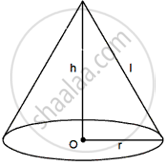
Total surface area of cylinder = 2πrh + 2πr2h, where r = base radius and h = height

= πr(r + l) + (2πrh + 2πr2) – 2(πr2)

= πr2 + πrl + 2πrh + 2πr2 – 2πr2

= πr(r + l + h)

= `pi"r"("r" + sqrt("r"^2 + "h"^2) + 2"h")`

shaalaa.com
  Is there an error in this question or solution?
Chapter 12: Surface Areas and Volumes - Exercise 12.2 [Page 142]

APPEARS IN

NCERT Exemplar Mathematics [English] Class 10
Chapter 12 Surface Areas and Volumes
Exercise 12.2 | Q 3 | Page 142

RELATED QUESTIONS

A right circular cone of radius 3 cm, has a curved surface area of 47.1 cm2. Find the volume of the cone. (use π 3.14).


2 cubes each of volume 64 cm3 are joined end to end. Find the surface area of the resulting cuboid.


A vessel is in the form of a hollow hemisphere mounted by a hollow cylinder. The diameter of the hemisphere is 14 cm and the total height of the vessel is 13 cm. Find the inner surface area of the vessel. [Use `pi = 22/7`]


A cubical block of side 7 cm is surmounted by a hemisphere. What is the greatest diameter the hemisphere can have? Find the surface area of the solid. [Use `pi = 22/7`]


Prove that the surface area of a sphere is equal to the curved surface area of the circumference cylinder__?


A toy is in the form of a cone surmounted on a hemisphere. The diameter of the base and the height of cone are 6cm and 4cm. determine surface area of toy?


In Figure 4, from a rectangular region ABCD with AB = 20 cm, a right triangle AED with AE = 9 cm and DE = 12 cm, is cut off. On the other end, taking BC as diameter, a semicircle is added on outside the region. Find the area of the shaded region.\[[Use\pi = 3 . 14]\]


From a solid cylinder of height 7 cm and base diameter 12 cm, a conical cavity of same height and same base diameter is hollowed out. Find the total surface area of the remaining solid. [User `pi22/7`]


Three solid spheres of radii 3, 4 and 5 cm respectively are melted and converted into a single solid sphere. Find the radius of this sphere.


A cylindrical bucket 28 cm in diameter and 72 cm high is full of water. The water is emptied into a rectangular tank 66 cm long and 28 cm wide. Find the height of the water level in the tank.


A solid is composed of a cylinder with hemispherical ends. If the length of the whole solid is 108 cm and the diameter of the cylinder is 36 cm, find the cost of polishing the surface at the rate of 7 paise per cm2 .


How many cubes of 10 cm edge can be put in a cubical box of 1 m edge?


Five identical cubes, each of edge 5 cm, are placed adjacent to each other. Find the volume of the resulting cuboid.


In the figure given below, ABCD is a square of side 14 cm with E, F, G and H as the mid points of sides AB, BC, CD and DA respectively. The area of the shaded portion is ______.


Khurja is a city in the Indian state of Uttar Pradesh famous for the pottery. Khurja pottery is traditional Indian pottery work which has attracted Indians as well as foreigners with a variety of tea sets, crockery and ceramic tile works. A huge portion of the ceramics used in the country is supplied by Khurja and is also referred as "The Ceramic Town".

One of the private schools of Bulandshahr organised an Educational Tour for class 10 students to Khurja. Students were very excited about the trip. Following are the few pottery objects of Khurja.

Students found the shapes of the objects very interesting and they could easily relate them with mathematical shapes viz sphere, hemisphere, cylinder etc.

Maths teacher who was accompanying the students asked the following questions:

  1. The internal radius of hemispherical bowl (filled completely with water) in I is 9 cm and the radius and height of the cylindrical jar in II are 1.5 cm and 4 cm respectively. If the hemispherical bowl is to be emptied in cylindrical jars, then how many cylindrical jars are required?
  2. If in the cylindrical jar full of water, a conical funnel of the same height and same diameter is immersed, then how much water will flow out of the jar?

Statement A (Assertion): Total Surface area of the top is the sum of the curved surface area of the hemisphere and the curved surface area of the cone.

Statement R( Reason): Top is obtained by joining the plane surfaces of the hemisphere and cone together.


Tamper-proof tetra-packed milk guarantees both freshness and security. This milk ensures uncompromised quality, preserving the nutritional values within and making it a reliable choice for health-conscious individuals.

500 ml milk is packed in a cuboidal container of dimensions 15 cm × 8 cm × 5 cm. These milk packets are then packed in cuboidal cartons of dimensions 30 cm × 32 cm × 15 cm.

Based on the above-given information, answer the following questions:

i. Find the volume of the cuboidal carton. (1)

ii. a. Find the total surface area of the milk packet. (2)

OR

b. How many milk packets can be filled in a carton? (2)

iii. How much milk can the cup (as shown in the figure) hold? (1)


Share
Notifications

Englishहिंदीमराठी


      Forgot password?
Use app×